


playing a mutual instrument
The Earth is an instrument. Its body vibrates constantly with the events that strike its surface and the depths of its mantle: geophonic infrasound generated by tectonic plates crashing into one another, grinding against one another, and ripping apart sections of the lithosphere; earthquakes; volcanoes and mountains being born, pushed and folded; the ubiquitous presence of the anthropophonic sounds of machines and pipes and electricity; and the minuscule biophonic vibrations of raindrops falling, trees growing, and insects burrowing through layers of soil. The Earth, as an instrument, plays restlessly across vast stretches of time, space and frequency. The resulting soundscapes are largely imperceptible for humans, either because they vibrate at such low frequencies that the human sensory apparatus cannot register them consciously, or because they vibrate only below the surface, inaccessible to the biomechanics of human existence.
The sound recordings throughout this essay take place in the desert environments of southern Arabia, in and around the oil and gas fields that have, over the past fifty years, restructured those environments into extractive territories of petromodernity. Here, the anthropogenic infrastructure of the petroleum industry penetrates the ground, pipes, pumps and oil wells sunk into the sand, where they become entangled with the endemic burrowed life of the desert. Together, living things and machines vibrate and resonate the Earth’s solid matter, generating sound. Recording and listening to those sounds is a means of engaging with the unknown subjectivities of the ground—the subterranean forms of existence in an incidental and involuntary relationship with the web of extractive and value-generating systems of fossil-fuel capitalism. The recording captures the simultaneity of anthropophonic, technophonic and biophonic phenomena, and thus argues for a recognition of a simultaneity of human and more-than-human subjectivities. This practice aims to decrease perceived phylogenetic distance and increase the potentialities of kinship with those forms of life that otherwise escape our perception and recognition. It asks what potential mutualities may arise when we temporarily suspend our perceptions of difference and un-understanding—not by “aiming to perceive what is imperceptible, [but in aiming] to perceive with the imperceptible” (Dennis, 2025). In other words, the shared instrumentality of groundsound may offer the possibility of recognising a potential other version of ourselves in playing a mutual instrument.
looking beyond the surface of the earth
The infrastructural and technological array of reflection seismology instrumentalises the same acoustic properties that let the body of the Earth perform as an instrument, for the transformation of acoustic traces of worlds out of view into perceptible data. The technology works by recording the invisible reverberations transmitted through the solid matter of the Earth's crust and mantle, using an array of sensors, and translating the captured data into a representation of the physical system in a format fit for human primary sensing and rationality—a visual model, an ‘image of the ground’. The Earth thus becomes incorporated into the technological apparatus of modernity as part of a sensorial instrument that allows us to see what otherwise remains invisibly far away or obscured by solid matter. The resulting noise-borne entanglements of living things inhabiting the ground, with the global dispersion of technology and Eurocentric modernity, transform landscapes from natural environments into terrains of political struggle.
In his essay ‘The Politics of Verticality’, Eyal Weizman describes the constitution of colonial territoriality that evolved in Palestine since 1967 no longer as a simple two-dimensional surface, but as “a large three-dimensional volume, layered with strategic, religious and political strata” (Weizman, 2002) that includes the air above and the soil beneath the ground. This territory is organised and controlled through the deployment of spatial and sensorial technologies, which expand on the compartmentalising function of the colonial administrative apparatus, producing “multiple separations, provisional boundaries, which relate to each other through surveillance and control” (Weizman, 2002). Achille Mbembe, in his reading of Weizman’s analysis, notes the “proliferation of the sites of violence. The battlegrounds are not located solely at the surface of the earth. The underground as well as the airspace are transformed into conflict zones. There is no continuity between the ground and the sky. Even the boundaries in airspace are divided between lower and upper layers. Everywhere, the symbolics of the top (who is on top) is reiterated” (Mbembe, 2003, p. 29). This multidimensional warfare broadens the scope of sites of violence and terror, with the widespread occurrence of demolitions and excavations, the construction of settlements and, critically, the absolute control of airspace through the use of “unmanned air vehicles (UAVs), aerial reconnaissance jets, early warning Hawkeye planes, assault helicopters, an Earth-observation satellite, techniques of ‘hologrammatization’” (Mbembe, 2003, p.29). These airborne sensorial technologies allow the settler colony to maintain control over Palestinian land, even where that land is not immediately accessible from the surface. Within this terrain, the instrumentalisation of the Earth’s acoustic properties slowly expands the necropower of settler colonial surveillance to also reach beneath the surface, and hold the solid matter of Palestinian soil in the same tight grip of control.
A recent study, conducted at Tel Aviv University, has identified an anomaly in seismic data readings for about 20 minutes before the commencement of the operation on October 7th. Utilising the technological infrastructure of seismology, the paper describes the production of a seismic model that reconstructs from recorded data the causal factors that have produced it. This is done through a sequence of translating, interpreting and visualising the recordings. All interpretation of seismic data relies on such models, a method that is highly sensitive to the reconstructive parameters of the model. To minimise the margins of error in each step of the processing sequence, and to maximise the accuracy and comprehensibility of the produced visualisation, processing times are extremely long, taking anywhere from weeks to several months for a single data set (MAJR Resources, no date). The research study concludes that the deployed model evidences the mobilisation of resistance bulldozers and pickup trucks towards the Gaza fence in preparation for the incursion, and thus claims the “potential utility of seismic noise measurements in identifying large‐scale terrorist vehicular mobilizations in advance” (Inbal, 2024).
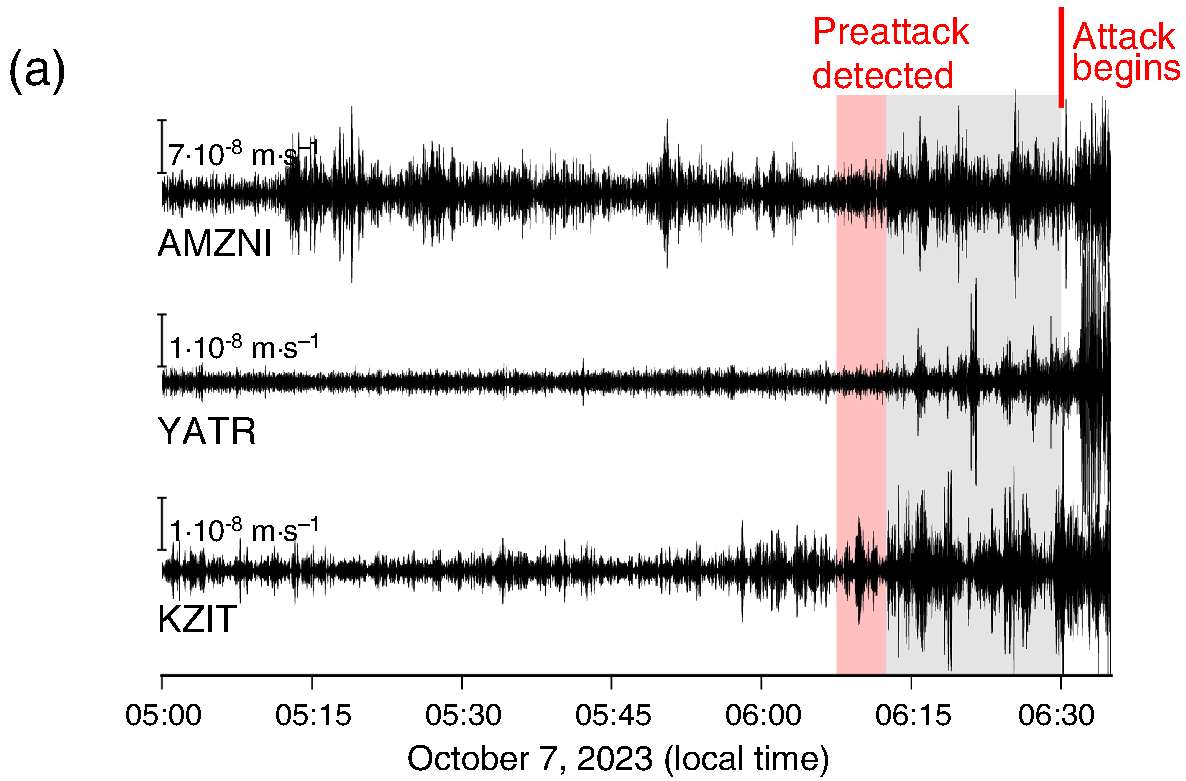
The seismic model, like all other models, is “an observation and a hypothesis. It’s both the data that constitutes it and a claim made from that data.” It becomes “a medium through which the present produces the future, though somewhat speculatively” (Lahoud, 2016). For the Israeli researchers, the reconstructive model parameters of abstracting the upper Earth crust in the study area into a “two‐layered earth model [with] synthetic spectral shapes for upper layer thicknesses of 20 and 100 m […], which are consistent with the width of the upper soft sedimentary layer” (Inbal, 2024), provides the necessary simplicity to rationalise the naturally complex accumulation of information in the recordings (noise), and thereby attribute the recordings speculatively, but confidently, to the vehicular movements of the Palestinian resistance. The model is both a simplified abstraction of the physical layers of Palestinian Earth crust, and the medium through which the subterranean layers of Palestinian land become entangled, alongside airspace, in the necropolitical mechanisms of the settler colony. It invents a world in which the Palestinian resistance could have been made visible, and thus subjected to state control, if only the processing of information could be done more efficiently. This futurity of full ground transparency is currently limited by capacities for data processing. Real-time applications are still unfeasible, as data interpretation is far too laborious. For now, “in the absence of other publicly disclosed sources of information, the seismologically based inferences regarding Hamas’ vehicle‐borne tactics remain speculative.” (Inbal, 2024) Recently, however, the inclusion of deep learning and machine learning systems in the interpretation of seismic data has expedited the capacity for data processing (Anjom, Vaccarino and Socco, 2023; Fernandes et al., 2025), a development that will inevitably produce training data for more complex seismic models, and eventually enable real-time visualisations at reasonably high resolutions. The seismic model constructs a potential future in which solid soil, and the vibrations perceived as sound that ripple through it, unfold in full visibility of the surveilling apparatus of the state. In feeding ground-borne sound through the model, this sound is reduced from a physical phenomenon to quantitative data. The sensorial reach of surveillance technology thus expands from on and above the ground, to below the ground. The instrumentalisation of Earth acoustics renders the ground itself transparent to the colonial gaze, and turns sound into a necropolitical agent.
weaponising sound
Contemporary reflection seismology is most widely used in the exploration of oil and gas deposits. It works by permeating an artificial seismic wave deep into the ground, where it reflects and/or refracts off the present material layers and then travels back to the surface to be captured by an array of sensors. Marine seismic exploration most commonly takes the form of a towed streamer survey, by which a specialist seismic vessel tows the survey equipment behind it. This includes one or two underwater high-pressure air guns that fire the sonic signal, and an array of cables containing hundreds of evenly spaced hydrophones that capture the reflected sound waves upon their return to the surface (CAAP, 2016). The sound required to reach the necessary depths, to travel through the vast volumes of water, and then more than 10 kilometres deep into the seabed and back, is immensely loud, with pressure levels of 220–250 decibels at the source. It is also impulsive and explosive, like a sharp crack or a popping balloon, or a shotgun blast. The petroleum industry claims complete safety of the survey technology, that there are no meaningful impacts on marine ecosystems (APPEA, no date), and that the surveys are carefully tailored to specific areas and planned to avoid sensitive times of the year (Shell, no date). The survey protocol requires that seismic activity only commences if no marine mammals are observed for a period of 30–60 minutes within a 500m radius of the sound source. This area is called the exclusion zone. If no mammal sighting is reported (other life forms are not considered in regulations), a soft start commences, whereby the “acoustic source is slowly increased from a very low level, to prevent marine mammals from entering the exclusion zone” (Shell, no date). The increasing volume of sound gradually produces an invisible boundary that should keep mammals from getting too close to the source of the blast. The seismic vessel then travels across the ocean surface in a predetermined pattern at a speed of about five knots, firing the sonic blast at full volume every 10–15 seconds. Once commenced, surveys carry on for weeks or months at a time, where some oceanic locations experience airgun sounds on more than 80% of days, for more than twelve consecutive months (Nieukirk et al., 2012).
Imagine a shot gun blast, every ten seconds, for 12 months, without end.
Whales are and have been entangled with the terrestrial life of humans, as “co-constructors of history and agents in shaping human life and culture” (Vieira et al., 2025), as objects of terror and appreciation, value and utility, and perhaps most inextricably, as part of our economic quests for resource accumulation and energy security. Historically, whales were direct targets of extractive violence, being hunted and killed to the brink of extinction for ambergris, baleen, meat and oil. Now they are collateral victims of the extractive technologies producing data for the petroleum industry. A full examination of the effects of seismic pollution is difficult, due to the immense spatial scales at which the acoustic life-worlds of whales unfold (Zandberg et al., 2021), but the “repeated and persistent acoustic insults [over] a large area…should be considered enough to cause population level impacts” (IWC, 2005). As a result of seismic surveys, humpback and fin whales stop singing to one another (NRDC, 2010). Bowhead whales and blue whales increase their calling rates, presumably in compensation for elevated ambient noise levels (Di Iorio and Clark, 2010), then suddenly stop calling altogether (Thode et al., 2020). Sperm whales decrease their foraging activities (Miller et al., 2009). Most species of whale are at least temporarily displaced from their regular habitats, their movement restricted by the moving invisible boundary of sound around the exploration vessel. The incessant noise intrusion silences communication, alters complex social and cultural behaviours, and prohibits whales from traversing those regions of ocean currently under extractive surveillance. Any and all possibility of communication beyond the industrial transfer of data, is drowned out. The seismic survey effectively destroys the whale’s capacity for social cohesion and cultural exchange (Day, Semmens and McCauley, 2023). The transboundary nature of sound, and its immense spatial reach, allows whales to relate to one another in behaviours akin to human sociality, culture and historicity (López and Santamariña, 2021). The same properties, instrumentalised for the technological apparatus of reflection seismology, allow sound to become the medium that forecloses non-human exercise of speech, thought and existence. This sound destroys the fundamentally sonic conditions for sustaining whale life.
The juridical regulation of anthropogenic seismic activity provides a limit to the power to execute surveys, but only within the limited 500m virtual sphere around the blast source, and in consideration only of the presence of marine mammals. While the pressure and thus volume of the sound wave decreases with distance, the true acoustic reach of the seismic blast extends far beyond the regulated exclusion zone. Noise from a single survey can impact an area of over 300,000km2 (approximately the land area of the Philippines, and then the volume of water within this area), and in this space raise background noise levels by two orders of magnitude (20 dB) (IWC, 2005; Weilgart, 2013). In the open ocean, the sound may be audible at a distance of almost 4000km. This true acoustic reach of the seismic blast produces an invisible, mercurial division of the surveyed body of water. Within the sonic boundaries, fluctuating and shifting as they are, living things are placed under conditions of permanent sonic terror, the attrition of their life accepted, ignored or denied by the industry benefiting from it. The results of a small number of studies on species other than cetaceans indicate that most, if not all forms of life suffer acute, cumulative and chronic effects with devastating consequences. Fish, like cod and saithe, exhibit signs of bradycardia (Davidsen et al., 2019), physical damage to their ears (McCauley, Fewtrell and Popper, 2003), and signs of increased stress, which impacts their reproductive capacity (Sierra Flores et al., 2015). Rock lobsters have difficulty righting themselves when placed upside down because of irreparable damage to the sensory organ that provides a sense of gravity and balance, similar to the human inner ear (Day et al., 2019). The true effect on other key marine life forms like sea turtles is largely unknown (Nelms et al., 2016). Perhaps most devastating are the repercussions on zooplankton, who play a critical role in maintaining the pelagic food web and the marine biological pump that sequesters carbon from the atmosphere. During a seismic survey, and within a much larger radius of the seismic blast than previously assumed, zooplankton populations die at rates two to three times higher than normal. Krill larvae are wiped out altogether (McCauley et al., 2017). These accumulating effects describe a transformation of underwater life-worlds, where living beings are no longer capable of sustaining some of the most fundamental aspects of existence. Sociality, reproduction, orientation and sensing are disrupted to such a degree that the life of those beings is consigned to what Lauren Berlant calls survival as slow death, a “physical wearing out” and “deterioration […] that is very nearly a defining condition of [the population’s] experience and historical existence” (Berlant, 2007, p. 754). Berlant describes the shape of the current biopolitical phase in capitalist society as a condition that does not prosper “in traumatic events, as discrete time-framed phenomena like military encounters and genocides can appear to do” (Berlant, 2007, p. 759), but rather as a continuity of circumstances in time and space, that, under the auspices of the normative and the ordinary, prevents a population from sustaining their own healthy existence. The acoustic infiltration of the seismic survey—the constant raised background noise in the ocean—creates precisely those conditions for the more-than-human life-worlds of whales and fish and lobsters and krill, who become, by force of sound, involuntary participants in, and collateral damage of, petromodernity.
The invisible sonic boundary of the survey circumscribes a shifting necropolitical space where living beings experience a totalising atmospheric violence (DeBoom, 2022) that diminishes life, and that consigns those beings to being “alive but in a state of injury, in a phantom-like world of horrors and intense cruelty and profanity” (Mbembe, 2003, p. 21). Without making a dangerous claim to universal experience, we can recognise that the involuntary incorporation of more-than-human life into the infrastructures and epistemes of petromodernity should grant those life-forms access to considerations about rights, subjectivity, sovereignty and justice, which are typically limited to a bound subset of human life. The epistemic tradition of Euromodernity has always sought to produce succinct distinctions between human and animal, culture and nature, and civilisation and savagery, to come to terms with, or justify, the violences of coloniality. Indeed, the very core of the subjectivity of Eurocentric modernity is the interminable urge for self-alienation, self-distinction, and the transformation of the self into a mastering subject, and nature into a mastered object (Horkheimer and Adorno, 2002, pp. 35–49). The consequent differential valuation of living beings, which is upheld by the construction of categories of economic value and taxonomic differentiation and perceptions of phylogenetic distance, allows for the continuity of sonic terror to be inflicted upon the bodies of living beings in the water. Only mammals, and primarily whales who are closest in biomechanics and sociality to humanity, are in very limited scope, considered in the regulation and limitation of anthropogenic seismic activity. The deterioration of krill, the total destruction of reproductive capacity in this species by way of killing all larvae within a radius of at least 1.2km of the sonic blast (McCauley et al., 2017), remains to date an acceptable byproduct of the extraction of petrophysical data. As a life form that perceives, behaves and relates in ways entirely unrecognisable as kin to humans, krill is entirely removed from consideration and grievability. Their existences are categorically and taxonomically inhuman, and thus definitionally severed from all reason, right and subjectivity. To be declared inhuman, in the epistemic field of coloniality, is to be declared a legitimate target for violence. Following this logic, the acoustically boundaried necropolitical space of the seismic survey juridically permits and rationalises ecological suffering for the perpetuation of “progress,” and can thus be described in terms that Achille Mbembe ascribes to the colony, as “the zone where the violence of the state of exception is deemed to operate in the service of ‘civilization’” (Mbembe, 2003, p. 24). The colony is a space where the judicial order is suspended, for it is inhabited by “savages,” and where “the sovereign might kill at any time or in any manner” (Mbembe, 2003, p. 25). The constitution of the colony relies on the “racial denial of any common bond between the conqueror and the native. In the eyes of the conqueror, savage life is just another form of animal life, a horrifying experience, something alien beyond imagination or comprehension” (Mbembe, 2003, p.24). In the seismic survey space, this necropower is exercised unrestrained upon the bodies of living things in their natural environment.
The hunt for ever more data, mediated through the instrumentalisation of sound, entangles and traps living beings in a web of economic relationships that dismembers their living matter, and epistemically re-assembles it as byproducts in the production of hydrocarbon resources. Their existences are indefinitely denied the potential for subjectivity, and are thus interminably subject to the acoustic necropower of seismology: neglected, ignored or eliminated. The constantly growing amount of data extraction through sonic sensing should be read as the instrumentalisation as weaponisation of sound, “deployed in the interest of maximum destruction of persons and the creation of death-worlds, new and unique forms of social existence in which vast populations are subjected to conditions of life conferring upon them the status of living dead” (Mbembe, 2003, p. 40). This instrumentalisation of sound actuates the mutilation of more-than-human life and produces the death of complexity, the death of the possibility for mutuality and conviviality, the death of autonomous subjectivities beyond the reduction of life to systems, and the death of life as such.
listening with noise
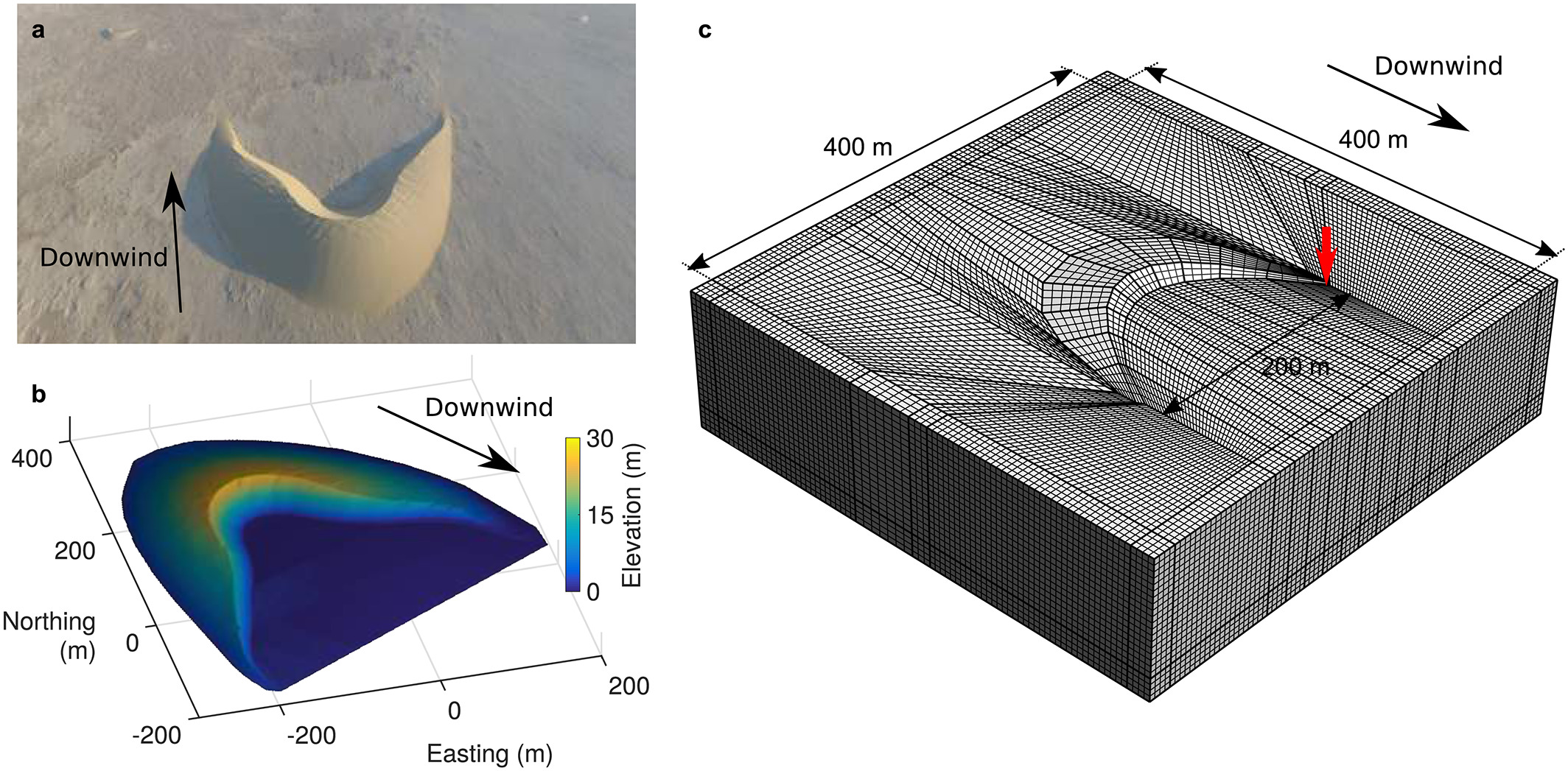
40% of the world’s confirmed oil deposits are located in the national territories of South West Asia and Northern Africa, territories characterised above all else by vast landscapes of hot and dry deserts. The desert terrain poses major challenges to the technological and sensorial infrastructure of the petroleum industry. Sand dunes create a rapidly changing surface topography that can quickly envelop artificial industrial structures. To prevent this, dunes are sprayed with polymers (Shifting Sands, 2021) or petroleum residues (Al-Soud and Al-Shakarchi, 2020) to form a crust that locks them in place for several years. In addition to their unwanted nomadic behaviour, dunes also challenge data acquisition as a major source of noise in seismic surveys. The loose sand granulate impedes easy wave propagation, while simultaneously, the dune (as a complex volumetric object) acts as an unpredictable echo chamber and resonator. Together, these properties severely degrade the signal-to-noise ratio of seismic data extracted from desert areas. In recent years, computational advances have enabled the production of increasingly complex sand-dune models that attempt to quantify their effect on seismic waves (Arran, Vriend and Muyzert, 2018). These models inform interpretation models for desert seismic data, increasing the ability to visualise sub-dune ground structures and potential hydrocarbon deposits. But efforts to quantify natural noise remain largely unsuccessful in reducing the dune's sonic complexity into productive knowledge. The sand dune continues to resist quantification and thus becomes an agent of resistance. The perceived nothingness of the desert, its shifting unrooted existence made from inert granular particles, becomes the very phenomenon by which it resists the visualising desires of machine and industry. Where the “seismic survey is the enabler and the key” (ADNOC Group, 2021, 1:46) for the fulfilment of these desires, the sandy desert continues to escape its gaze.
The sensorial apparatus of reflection seismology seeks to clarify and quantify properties of natural noise into objective data. In the process, it constructs and maintains a totalising organisational principle for the planetary ecology that denies both the autonomous subjectivity of life-worlds beyond the bounds of extractive capitalism and human subjectivity in material, political, and spiritual entanglement with an animated and animistic world. The technological instrumentalisation of sound for extracting hydrocarbon resources enables the reduction and corruption of the noise of the Earth. The desert is the terrain where this noise reaches its peak potential to disrupt the instrumentalisation of Earth acoustics. With grains of sand and grains of noise it continues to insist on its opacity in the face of the piercing, clarifying gaze of rationality—the opacity that, for Édouard Glissant (2010, p. 190), is the real foundation of Relation: “For the time being, perhaps, give up this old obsession with discovering what lies at the bottom of natures. […] Thought of self and thought of other here become obsolete in their duality.”
The recordings in this essay of ground-sound noise from oil and gas fields in the desert repurpose the notion of sound extraction to challenge the denaturing rationalities of instrumentalised/weaponised sound in reflection seismology. The mingled vibrations of Earth matter, animals and machines gesture at a potential for mutuality and conviviality with more-than-human life. Both the moment of recording—sitting by the oil well, skin sticky from petroleum residue in the air, ears connected via wires to the aural signs of life in the ground—and the recording as somewhat abstract artefact resulting from it, provide opportunity to sense the more-than-human subjectivities of the subterranean, to imagine the noise of the world as vocalisation without words. As such, this practice constitutes a form of what Paulo Freire (1994) calls critical hope: thinking and engaging with non-Eurocentric perception that escapes the dominant logic and invites us to be in communion with the perceived subject. In engagement of the sensory experience of perception, both the process and the artefact of recording are expressions of phenomenological thinking, which is “not just a logical function of ‘representing’ what is, here and now in the present, but operates at deeper levels in its ‘recalling’ of what has been forgotten and its ‘projecting’ what might yet come to pass in the future” (Marcuse, 2007, p. 234). Positioning the recording as an artefact is not a representation of some external materiality, but a rejection of the representative mechanism and the aesthetics of modernity. It invites an interpretive speculation about alternative ways of sensing, perceiving and thus producing relations and politics with the world as a “multiplicity in totality” (Glissant, 2010, p. 192). But where classical phenomenology strives towards a clarification of the disorientation that arises from a recognition of multiplicity, the presenting of recording as an activity, and the recording as an artefact, revels in ambiguity—in the noisy, blurry potential for mutuality that arises from not knowing where it is that I am hearing. Listening intently lets us stay with the disorienting moments of overlapping anthropophonic, technophonic and biophonic noise, so that “we might achieve a different orientation toward them; such moments may be the source of vitality as well as giddiness. We might even find joy and excitement in the horror” (Ahmed, 2006, p. 4). Sound, then, rather than an instrument of extraction, becomes the critical driving mechanism of relationality and the medium that allows for an engagement with the inherent unknowability underneath all knowable things.
The Earth is an instrument, and the noises it can make reject “the regulation of taste and the imposition of particular standards of beauty” (de la Fuente, 2024). Noise, before being organised into what we call music, is pure aesthesis, a priori ungoverned by the rules of aesthetics. Noise is also simultaneously the absence of data, and the epistemic opposite to rational meaning in data. Consequently, rather than constructing the authoritative meaning of petrophysical quantification, noise, in indeterminacy, allows for a participatory relationship between the subjects and objects making noise, and the subject listening to, for and with noise. In other words, it can, to the listening ear, be recognised as a new kind of expression, another kind of music. As Jacques Attali (1985, p.11) reminds us: “The noises of a society are in advance of its images and material conflicts. Our music foretells our future. Let us lend it an ear.” In listening to the noise of the Earth, we may yet become kin.