


Imagining large-scale invisible systems from a human perspective can feel like an abstract and unwieldy exercise. When these systems are planetary, like a weather system or a microbial network, the vastness of their scale and physical effect seems out of human sense, perpetually mysterious and understood after the fact. The binary – between the known, visualised, and human scale, and the invisible planetary, becomes complicated in human-built systems like Artificial Intelligence Large Language Models (LLMs). While the data and training centres are certainly physically located (though often in hinterlands far from most who utilise them), their effects are both invisible and planetary. It is difficult to react or respond to systems that operate on both planetary and human scales. The mystery of these unseen systems and their repercussions may feel beyond human control, even for the hands that engineered and built them.
To understand this new entity, it can help to contextualise it within the history of another large-scale, human-engineered project. In this article, I attempt to make the methods and understandings of LLM systems tangible through the context of the Vaal Dam and the Integrated Vaal River System (IVRS), a large-scale hydrocolonial damming project in South Africa. This hydrosystem provides municipal water to the major metropolis of Johannesburg and its surroundings and is the source of potable water in a landlocked city built for gold mining.
Johannesburg began in 1886 as a colonial mining outpost (South African History Online 2026). Its early existence, and so the initial political and municipal structures, were formed around extractive practices that were racially divisive and equated blackness with labour (Mbembe and Nuttall 2008, p.17, Yusoff 2018, p.35). The Vaal Dam was filled in the early 1930s in response to the gold industry’s water-dependant methods of ore extraction that had emptied, or severely polluted, the small streams and aquifers around the town that would become the city (Tempelhoff 2003, p.157). The present day postcolonial city no longer relies on mining extraction, but the colonial political and municipal structures still affect and perpetuate disparity. The Vaal Dam continues to accumulate water to support the city, relying on surrounding rivers, as well as the Lesotho Highland Water Project, as extracted sources held in the reservoir of the dammed Vaal River.
Both LLMs and the Vaal Dam are large-scale systems of containment. Both orient towards the extraction and accumulation of resources as a source of capital wealth and power. Both decontextualise that which they accumulate and deliver, offering only the requested output of water or information, without reference to the environment or position from which it may have been sourced. The four thematics offered here are based on my ongoing research into hydrocolonial damming in and for South Africa (Barnett 2024), and are intended to frame the relational reading so that both systems are considered, and imagined, as operating under a common set of colonial logics. Accumulation thinks through the training of LLMs through the amassing, scanning, and subsequent destruction of paper-based knowledge by AI company Anthropic in relation to transnational damming; Homogenisation engages with the formulation of quantifiable, monetised resource from ‘raw’ material, a process that insists on a singular, unwavering output; Hypermaterial made invisible offers dam- and data centre-based examples of hinterland systems that separate the users from material processes; and Speculation describes prepaid water meters in historically black, low-income neighbourhoods in Johannesburg that can offer a projected future for LLM capitalised use.
To think visually and extend the tactile understanding of these systems beyond the written, this article includes references in the form of watery prints, drawings, and a photo collage. These interpretations act as methodological prompts to the argument rather than illustrations of the text. This method points to an expansive, multidisciplinary analysis that engages sensory knowledge and subjective interpretation, offering a conceptual counterpoint to a homogenised, singular truth suggested by LLM outputs. Framing LLMs in relation to Johannesburg’s water raises questions of materiality, extraction, and quantifiable worth (within the field of hydrocolonial municipal water) of largely invisible and far-flung digital platforms that collect and process human knowledge in writing.
Accumulation
In January 2025, a news story in the online publication Ars Technica (among other online sources) brought attention to the actions of AI company Anthropic, which mass-purchased and then “cut millions of print books from their bindings, scanned them into digital files, and threw away the originals solely for the purpose of training AI” (Edwards 2025). The visual image of the vast extraction from paper pages, of human stories, arguments, listings and techniques, and the subsequent annihilation of this material repository and transfer to digital data, gives a physical form to a system of accumulation and containment that is otherwise most often immaterial and largely invisible. The books’ destruction represents the cost of accumulating human knowledge. While Anthropic’s reasoning for purchasing the publications was to comply with legalities of copyright and intellectual property ownership,1 and the books’ ruination as a result of the unforgiving process of scanning the texts for training, the result illustrates a method of “accumulation by dispossession” (Harvey 2003, p. 144), familiar to many capital- and colonial-driven contexts. David Harvey’s theory describes the centralising and consolidation of wealth and resources by the privileged few through the deprivation of a greater public. In this case, books and the knowledge they contain are treated as a finite, hoardable resource, particularly in relation to eradication after scanning. Removing the texts from future circulation (through their destruction) can be understood as dispossession of potential knowledge-based interpretations. While an individual book as a material object is subject to wear and eventual decay, the extraordinary number Anthropic destroyed represents a significant extraction of information from public access.
The Anthropic example may be a useful visualisation of stockpiling a physical volume of knowledge, but the book medium is, in some ways, limited. Information, language, and the meaning they offer and disperse are not only distributed as printed words on paper or a digital screen, but also traverse fluid channels of spoken word, perceptions, interpretations, and experiences that may not be articulated in a form that can be effectively contained. In this way, information can be likened to water. Present in, and shifting between, the states of liquid, gas, and solid, this elemental force is both held within bodies (from oceans, lakes, dams, and reservoirs to organisms, human and non-human), and escapes from these containers (through leaking, evaporating, precipitating, and saturating). This association is not new or extraordinary. Wet analogies of ‘data flows’ held within ‘the cloud’ are suggested by tech industry communication as a way of understanding the materiality of invisible data systems (which are necessarily dry) in media and communication. In both, the methods of containment and accumulation depend on significant extraction and energy resources to be effective. While the language around LLMs might utilise the wet, the physical landscapes surrounding data centres are progressively transformed, sometimes literally, from wet to dry in an effort to keep systems cool in hot climates.
Figure 1 engages with the ways in which concepts of wet and dry may come to be associated with oppositional states of being within and beyond the physical. The monotype print depicts the Katse dam wall in Lesotho, which appears as the only solid form in a swirling wet environment. The wall represents the emotional state of dryness: as safe, objective, and stable, while the watery landscape leans into the messiness, overwhelm, and urgency of wet submersion.
%20Dam%20Works%20VI%20watercolour%20monotype.jpg)
Figure 1: NDam Works VI, watercolour monotype (Barnett 2022).
In the dry landscape of drought-prone South Africa, these wet and dry associations have been used to justify state control and the unequal distribution of water through systems of extraction and damming that have amassed and (unequally) distributed this resource under colonial, apartheid, and post-apartheid systems. The IVRS offers a valuable example of this, in which the flow of several rivers (the Vaal, Wilge and Tugela Rivers in South Africa, and the Senqunyane, Malabatse and Bokong Rivers in neighbouring Lesotho) has been extracted and co-opted into the Vaal Dam, transforming a seasonally flowing (wet, dry, or both) Vaal River into a sprawling 2.5-billion-cubic-metre-large body of quantifiable, monetised, and continuous resource. This water is piped from the Vaal Dam to Johannesburg’s municipalities, which offer access to this water at a specified price. This water is endlessly available to those with the means to pay, and restricted from those unable to pay. This offers a similar example of Harvey’s accumulation by dispossession, in which water is amassed and released in ways that fortify social stratifications of wealth and power. Isabel Hofmeyr identifies this relationship as hydrocolonial (Hofmeyr 2021, p. x), tying Harvey’s capitalist logic to a history of colonial power relationships of exploitation. The accumulation of water within dams and reservoirs can also be understood as a shift in the conception and designation of the fluid: from a vital entity operating in diverse ways according to environment, geology, seasons, and climate, to a regulated, extractable resource understood in terms of quantity.
Homogenisation
%20Photocollage%20of%20a%20dam%20structure%20in%20a%20turbulent%20flow_.jpg)
Figure 2: Photocollage of a dam structure in a turbulent flow (Barnett 2026).
The containment and transformation of the nature of one elemental state into its opposite, such as from wet to dry, can also be framed as an effort to homogenise chaos into order. Figure 2 is a collaged effort to think through this shift and its required abstraction. In it, a cut-out of a watercolour drawing depicting a cross-section of a dam structure is placed atop a photograph of swirling, churning water flowing from the Ash River Outfall, where water from the Lesotho Highland Project enters South Africa. Collage insists on one image being read in relation to another without transition or consideration; both turbulent water and the dam are reduced to simple oppositions. Simplification of resources, in the case of damming and LLM production, offers a useful system of organisation and control.
In ‘Turbulent circulation: building a critical engagement with logistics’, Charmaine Chua, Martin Danyluk, Deborah Cowen, and Laleh Khalili describe capitalist global logistics as “a universalizing logic of abstract flow” (Chua et al. 2018, p. 1). This conception can be applied to the systems of both water storage and distribution, such as the Vaal Dam, and to digital forms of information accumulated, processed, and circulated through LLMs. In all three cases, matter (whether physical or digital) is abstracted into a homogeneous mass and valued for its continuity and movability rather than its specificity. Water, as it flows from the municipal tap, is not understood to be connected to the rivers, dams, and waste streams from which it originates. It is only water, considered a neutral, safe, and unchanging utility. Information, as it appears as the answer to a question in an LLM, is similarly assumed to be an impartial, truthful, and unbiased repository accessed in a single, mediated manner. Both systems encourage the assumption that each resource is a single, homogeneous entity, and capitalise on this belief.
The efforts towards homogeneity in water can be understood through a chronological (and, within the South African context, a colonially oriented) lens. Jamie Linton writes extensively about “modern water”, which he designates to highlight how water is treated and understood within a present-day global context. He describes modern water as manageable: “not complicated by ecological, cultural, or social factors”; as universal: “all waters, in whatever circumstances they may occur, are reducible to this abstraction”; and as natural: “not only may all waters be reduced to H2O but the product of this reduction is understood to constitute water’s essence, its basic nature” (Linton 2010, p. 8). These features identify the usefulness of this imagined abstraction of water, reduced to a singular, untethered utility entirely in service of human needs. Abstraction becomes the justification for extractive, resource-driven actions that ignore the particularities of a water’s context. In the IVRS, this occurs more blatantly within the Lesotho Highlands Project, where the Senqu-Orange river system from South Africa’s neighbouring nation has been contained in the Katse and Mohale Dams, and the water directed into transnational channels that flow into the Wilge River, which empties into the Vaal Dam. From a South African perspective, this water is a passive resource: a natural, manageable, and universal material that is bought and controlled (within the borders of Lesotho) by the South African government. The purchasing of this water similarly reduces it to a commodified (and so isolated and abstracted) entity.
The extraction and treatment of this water can further be understood in relation to the colonial and apartheid-era mining industry of South Africa; a racially hierarchical system that produced singular, economically valued metals at the expense of black lives and labour. Kathryn Yussof (2017, p.35) describes the racial implications of geological extraction, and the colonial and political power instituted through resource-oriented, capital-driven industries controlled by foreign nations. Considering water as an entity valued like geological wealth within colonial environments articulates the connection between homogeneous resources and hierarchies of power that invisibilise the contexts and labour of those without power in the service of an unfettered, commodifiable product.
Connections between homogeneity, resources, and hierarchical power relationships can be understood in the context of LLMs and the monetisation of knowledge materials. LLM technology processes information sourced from many disparate forms of writing (primarily digital and physical publications), which is used as raw material to train programmes like ChatGPT by OpenAI or Claude by Anthropic, in an effort to produce intelligent output. These models and their outputs are highly valued, ostensibly offering a seamless and unequivocal route from question to the most rational, intelligent answer, like the invisible flow of water from dam to municipal tap. Kate Crawford interrogates this myth of the neutral authority of intelligence divorced from its context. She describes the misconception “that intelligence is something that exists independently, as though it were natural and distinct from social, cultural, historical, and political forces. In fact, the concept of intelligence has done inordinate harm over centuries and has been used to justify relations of domination from slavery to eugenics” (Crawford 2021, p. 5). The power and positioning of intelligence become visceral in Crawford’s example, illustrating the ease with which justifications for violence and hierarchical power dynamics can hide behind objective, uncontextual, and undeniable truth. Crawford considers the AI industry’s desire in homogenising and controlling intelligence as being “not to create an atlas of the world but to be the atlas – the dominant way of seeing. This colonising impulse centralises the power for those who control major AI corporations: it determines how the world is measured and defined while simultaneously denying that this is an inherently political activity” (Crawford 2021, p. 11). Recognising this effort as centralising, as a colonial impulse, puts LLMs within a context of historical power relations, which is necessary when considering problematic outcomes and effects of this new technology.
Alongside the hierarchies of power implicated in intelligence homogenisation is all that is lost when knowledge is centralised. In consolidating the immensity of written language into a singular, statistically average voice, systems of understanding that engage with complexity and contradiction as ways of knowing may become less potent, or indeed forgotten. The divergence between the written and what is understood orally, physically or experientially risks widening. Deepak Dennison warns of this “feedback loop that narrows the scope of accessible human knowledge”, suggesting that, “What’s at stake, then, isn’t just representation: it’s the resilience and diversity of knowledge itself”(Dennison 2025).
The dangers of homogenisation of intelligence can be framed in relation to the water of the IVRS and its orientation towards safety. While the Vaal Dam is the major source of municipal water in Johannesburg, the water it holds is highly saturated with chemical, organic, and industrial pollutants. The water is processed at the Rand Water Zuikerbosch purification plant before it is pumped towards the city’s municipalities. Johannesburg residents regularly express concern about the purification process and the safety of the cleaned water (though they do not often orient their worry towards the major polluters of the dam itself) for drinking and bathing. These anxieties press for further homogenisation, and illustrate a broader insecurity in the national systems that deliver the water. Water, in this case, is reduced to a clean-or-dirty metric, stripped of ecological, political, and environmental meaning and purpose beyond basic utility.
Hyper Material Made Invisible
%20Watery%20interpretations.jpg)
Figure 3: Watery interpretations of data centres and circuits on responsive paper (Barnett 2026).
Figure 3 engages with the physical image of data centres to upend proposed homogeneity. It offers an ink-and-water depiction of a Nvidia AI computer chip,2 drawn on Japanese washi paper. The paper is especially water-receptive, so each mark made ‘bleeds’ outside of the intended line or square. A data centre (located in Vernon, California) is drawn on top of the circuit board. In the making, this drawing insisted that the properties of liquid be as present as the describing hand, so that the will of depiction had to contend with the physics of materiality. The result is a muddy composite, where forms are more and less visible, floating and interacting between illustration and material chance. The drawing draws attention to its materiality as much as to what it represents, which, in turn, is the material manifestation of a system imagined to be invisible.
Both LLMs, which deliver information, and the system that delivers water to Johannesburg taps, are intended to appear immaterial and invisible, at least to the end user. This invisibility of the systems behind information retrieval or water delivery prevents a visual or tactile understanding of the systems that produce the output. As a result, there is little to no questioning of the conditions or contexts of their production, and no conception of the output in relation to its past or future, beyond its singular existence in the present. Both are hyper-material and labour-intensive, compromising distant hinterlands and communities with lasting effects to produce a consistent, unsullied output divorced from context.
The Vaal Dam’s saturation with waste illustrates invisible hypermateriality. While water is considered safe when transparent and chemical-free, it is also an essential medium for cleaning. When waste-filled water is flushed away into waste pipes or downstream, it is immediately removed from the user’s awareness and responsibility. Pamela Gupta, Sarah Nuttall, Esther Pereen, and Hanneke Stuit note how waste (as well as waste-producing industries) is pushed out of cities and into hinterlands (Pereen et al., p. 8) in an effort to invisibilise the sensorial and health-related contaminants they emit. In Johannesburg, wastewater treatment plants on the city’s outskirts intended to reclean the sullied water regularly malfunction, sending human-waste sewerage into water systems that drain into rivers; those south of the city empty into the Vaal Dam. The electrical energy and labour used to remove contaminants from the water (which is then recontaminated), as well as the energy needed to pump the water 80 kilometres uphill towards the highveld area of Johannesburg, go largely unnoticed, only highlighted when these processes fail. This energy is generated from coal plants that further pollute the air and water of hinterland areas. The materiality of the clean and wastewater cycles that sustain the city has been designed to be entirely contained and mostly unseen, surfacing and disappearing on instruction in sinks, bathtubs, toilets, and faucets. When residents notice a rupture in the continuity of water flow or cleanliness, and water is restricted or too visible through surface leaks, the system becomes tangible and fraught. Disruptions in water services are political within Johannesburg, where water access has historically been utilised as a tool for racial capitalism. When the water stays in its pipes, channels, and distant dams, it can be harder to motivate the system’s prioritisation and built-in dysfunctions. Materiality, in this way, brings attention to the cost of a system.
AI is similarly removed from the processes that enable its functioning and existence, even within the language used to describe it. References to ‘the cloud’ identify this imagined space as light and airy, a floating accumulation of digital knowledge that is ever-present and innocuous. The digital cloud is imagined as waiting patiently and invisibly for the user to draw from it, attentive to the user’s needs, but needing nothing of its own. This fictitious image separates the medium of information from its earthbound architecture, where it can be assumed to be apolitical, disembodied, and obedient. This immateriality could not be further from reality. As Tung-Hui Hu writes in A Prehistory of the Cloud, “The cloud is a resource-intensive, extractive technology that converts water and electricity into computational power, leaving a sizable amount of environmental damage that it then displaces from sight” (Hu 2015, p. 146).
The weighty, destructive and extraordinarily physical effects of AI are dispersed to many global hinterlands. Widely sourced natural resources and fuel are needed to power coal plants that supply the growing data centres with vast amounts of electricity to run and cool their infrastructure, all of which are located on the outskirts of cities. The written input, the training for LLM models, and logistics at each stage of development and process require a wide and unseen network of past and present human labour. The invisible and dispersed hypermateriality draws attention to the scale of capital required to build and maintain these vast energy-heavy systems and, with it, the political, extractive and social structures they must depend on. Crawford suggests that these factors position AI systems that are “ultimately designed to serve existing dominant interests. In this sense, artificial intelligence is a registry of power” (Crawford 2021, p. 8).
There is power, in both LLMs and Johannesburg’s water system, in negating the relationship between material and environmental consequence, capital, and the political. This separation allows the outputs of water and information to be utilised without responsibility or understanding of the material weight and destruction required in their processing, further offering these outputs as utilities that are essential for the human lives that use them. When an output is essential, all power is given over to those who control it.
Speculation
This comparison of material human necessities like municipal water with the intelligence produced by LLMs is presently being championed by Sam Altman, CEO of OpenAI, who recently stated: “We see a future where intelligence is a utility like electricity or water and people buy it from us on a meter and use it for whatever they want to use it for” (Spirlet 2026). This comment points to the centralising and commodifying of all digital knowledge systems through the singular framework of AI. The evocation of a measurement system in the context of Johannesburg draws attention to the prepaid water meters installed in low-income areas of the city from the early 2000s under the Municipal Systems Act 32 (South African Government 2000), and the partial privatisation of water under the company Joburg Water. Prishani Naidoo (2005, p. 156) has written about the effects of prepaid meters in Phiri, Soweto, arguing that low-income communities should not be denied the right to water because of water privatisation. Meters were, and continue to be, installed primarily in low-income areas of the city, while wealthy residents receive an unmetered flow, confident that their water bills will be paid in the future. The time of payment (before or after the water has been used) may seem arbitrary, but in a city with a history of unequal, racially striated water access, the meters echo historical discrimination and reinforce a difference in rights between the wealthy and the poor. Altman’s comment celebrates and encourages these hierarchical capitalist structures, which have the potential to further entrench a separation of information access that is historically racial and unequal.
%20Prepaid%20water%20meter%20wet%20drawing%20on%20absorbent%20paper_.jpg)
Figure 4: Prepaid water meter wet drawing on absorbent paper (Barnett 2026).
Considering the production and measurement of abstracted materialities, another watery drawing renders Johannesburg’s prepaid water meters on an absorbent surface. When the borders of this municipal object undulate and begin to represent what it monitors, outputs and withholds, the object is no longer neutral but operating in (and subject to) the complexity of the surrounding environment, both physical and social. In this way, a utility is acknowledged as porous to the political, environmental, and social history in which it functions, even in its efforts to homogenise that which it meters out.
This metering of intelligence as utility also signifies the homogenising of knowledge into a single continuous flow, neutral and averaged out so that the quality is consistently the same. When information is singular and universally positioned, we assume that it represents objective and undeniable truth (Puzio 2025, p. 16). Similarly, when water is transparent, without smell or sediment, it is considered safe and ‘true’ to its designation. In both cases, divergences or irregularities may be treated with doubt and suspicion, but may actually offer an accurate representation of the multitude of needs, positions, and outcomes of human-derived systems. The Vaal Dam’s saturation, its slurried heterogeneous accumulation of extraction, waste, run-off and dispossession, is necessary evidence of the political reality it exists within. Its muddy materiality encourages an understanding of water beyond utility and outside the delineations of clean and dirty, since this water was and will eventually and continually be both. When an LLM produces a non-truth, it is deemed an “hallucination”. The framing of this inaccuracy as an imaginary vision of a (typically human) brain points to what these systems may offer beyond the semblance of clean, homogeneous truths. As a brain hallucination may contain the seeds of new and unusual knowledge connections within a soupy incoherence, AI untruths may offer lessons that reflect the cultural and capitalist logics coded into digital systems.
.%20%20Nina%20Barnett%20(2026)%20.jpg)
Figure 4: Relief print and monotype sketch to think through porous heterogeneity (Barnett 2026).
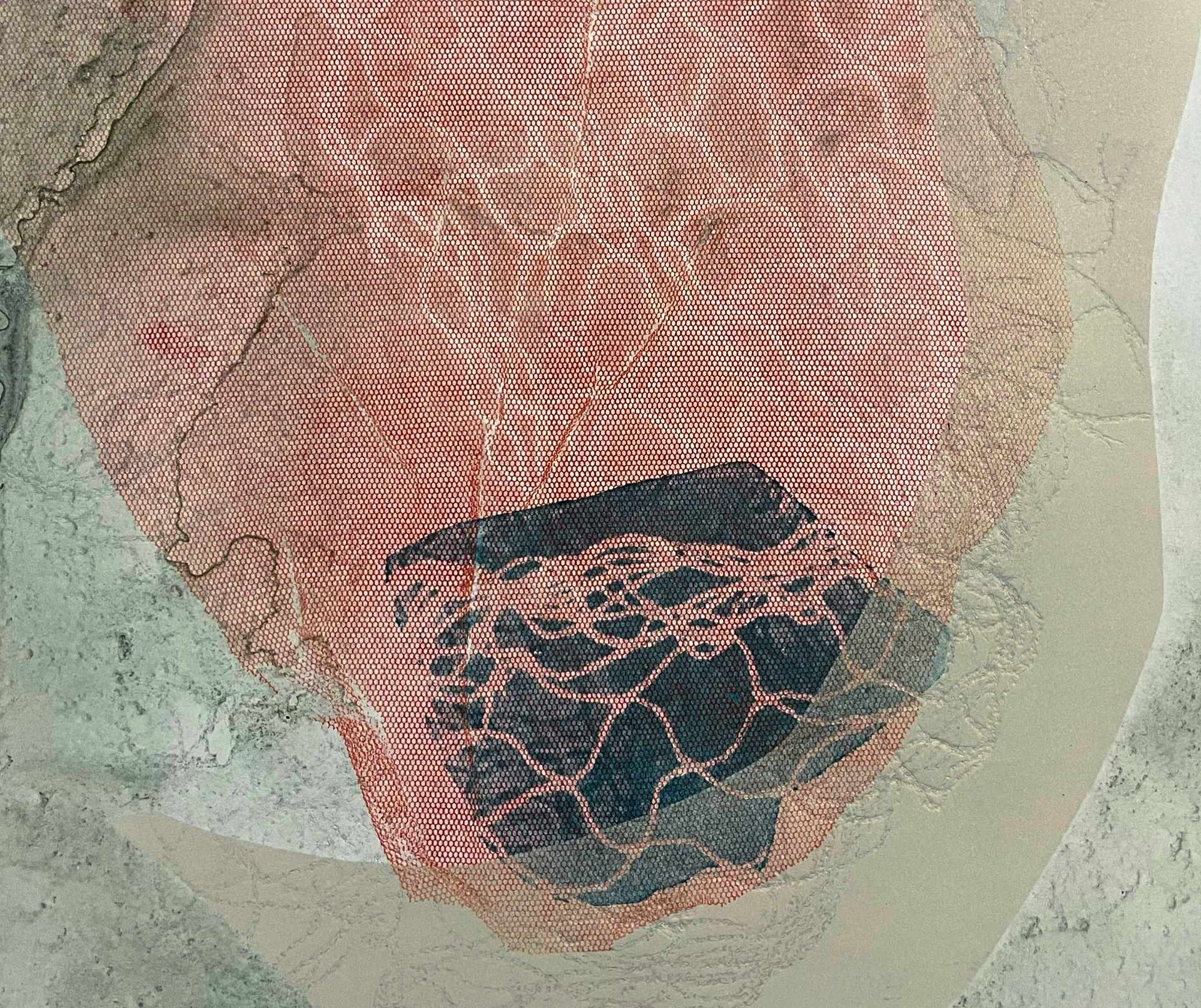
In Figure 5, a layered relief and monotype print combines oil-based printing processes with watercolour. Two types of netting create positive and negative imprints, while the solid shapes inside and outside the netting play with weight and density. This meditation on containment and porosity came from watching fishermen on the banks of the Vaal Dam. When a net is submerged, it may hold some materialities in place, but water is freed to move between states of containment. The water is the environment, or the medium, rather than that which is subject to control. Dilip da Cunha and Anuradha Mathur propose an understanding of water that is freed from the constraints of the hydraulic cycle, where it is recognised as “precipitating, seeping, soaking, evaporating, and transpiring in ways that defy delineation” (Da Cunha and Mathur 2009, p. ix). This description can offer a valuable analogy when describing knowledge: understood as necessarily turbid, sensorial, and uncontained, a flooding of many inputs through which meanings are made at moments of porosity. Knowledge, like water, is always and necessarily in motion, adapting with each iteration according to the medium and position of both giver and receiver. Each articulation offers new imaginaries through translation and emphasis, similarly defying the boundaries of purpose and potential.
Conclusion
LLMs are currently oriented towards homogeneous utility in how information is accumulated, processed and distributed, but this denies the numerous possibilities the technology can offer for prompting human imaginaries and expanding possible understandings. A flicker of the expansive potential offered by LLMs may be seen in the untruths or “hallucinations” that occasionally appear as answers to user requests. On their website, Chrystal China suggests that the LLM “perceives patterns or objects that are nonexistent or imperceptible to human observers, creating outputs that are nonsensical or altogether inaccurate” (China 2023). As in the case of Johannesburg’s water (that is more than the homogeneous resource under state control), LLM outputs have the potential to be known beyond the binary of request and standardised answer. In recognising the capital-driven and extractive methods that are similarly found within both large-scale systems, there is an acknowledgement that these methods of containment deny an unbounded, ‘nonsensical’ logic that leaks, or which computational misbehaviours insist on. In making space for this visible porosity instead of calling it out as anomalous, the resource becomes a curiosity to be learnt from; a new facet of reflection of the environment, or the human.