



Introduction
How do we come to recognise and appropriate what is always present, yet neither seen or touched? In the Physics (1930), Aristotle argues that an absolute void cannot exist, demonstrating through the ratio of motion and time that what many scholars claimed to be ‘empty space’ was in fact filled with ‘air’. That is, he argued, that a void does not exist because it cannot be measured or compared. For a long time, debates over the vacuum and air did not overturn his dominant view. In the mid-17th century, Western scientists such as Evangelista Torricelli and Otto von Guericke first attempted to measure the volume and weight of air. At that moment, invisible gas was reduced to the numerical value of ‘mass’ and ‘air’, previously a philosophical or theological concept. It then became a measurable substance and governable object.
The Industrial Revolution of the 18th century changed the status of air. As coal combustion rapidly increased during this period, concerns over air pollution became centred on its effect on human health (Fowler et al. 2020). The large-scale burning of coal and oil led to a dramatic increase in atmospheric carbon dioxide concentrations, and it wasn’t until the mid-20th century that scientists began to observe that the changes were affecting the global climate system. In 1958, Charles David Keeling began continuously measuring carbon dioxide (CO₂) concentrations at Mauna Loa, Hawaii, and the resulting ‘Keeling Curve’ became the first quantitative evidence that human activity was altering the atmosphere's composition (American Chemical Society 2015). This provided direct evidence that atmospheric CO₂ was increasing year on year and became the baseline for climate policy discussions.
CO₂ has since been identified as one of the main culprits in the climate crisis, and the international community has begun to imagine carbon as a tradable unit, as something that needs to be reduced (UNFCCC 1997). In 1972, the UN Conference on the Human Environment (Stockholm Conference) put environmental issues on the international political agenda for the first time, and in 1979, after the first World Climate Conference, climate change became politicised rather than just a matter for scientists. Over the following decades, this broad category of ‘the environment’ was steadily narrowed into the more specific and measurable category of ‘climate change’, a process consolidated in 1988 when UNEP and the WMO created the Intergovernmental Panel on Climate Change (IPCC), to formalise the link between science and policy (UN General Assembly 1988). This narrowing was not a neutral linguistic adjustment; it was the same kind of reduction that would later allow an entire forest ecosystem to be measured and traded as a single unit of carbon. The 1992 Rio Earth Summit led to the signing of the UNFCCC, which officially recognised climate change as a global problem and adopted a framework agreement aimed at stabilising greenhouse gases. The Kyoto Protocol, adopted in 1997, established legal emission-reduction obligations for industrialised countries and introduced three ‘flexibility mechanisms’: international emissions trading, joint implementation, and the Clean Development Mechanism (CDM), which introduced the concept of carbon credits (UNFCCC 1997).
A carbon credit is a tradable right that quantifies the ‘abatement performance’ of reducing greenhouse gas (GHG) emissions from the atmosphere by one tonne of CO₂ equivalent (tCO₂e), or of absorbing them. CO₂e is not just a unit that measures carbon dioxide, but is used to measure all different types of greenhouse gases. By unifying multiple GHGs into one unit, it becomes easier to quantify their global warming potential (GWP) and to harmonise the system. Thus, one carbon credit represents one tonne of carbon dioxide, or the equivalent of a GHG emission right or offset, issued when a certified emission reduction activity (such as reforestation or a clean energy project) reduces GHGs by that amount. The Bali Action Plan of 2007 (UNFCCC 2007) opened negotiations on policy approaches and positive incentives for reducing emissions from deforestation and forest degradation in what the UNFCCC terms ‘developing countries’, a process that would establish REDD+ as a mechanism through which forests conserved as a greenhouse gas ‘sink’ could eventually be converted into tradable carbon credits. Central to this mechanism is that REDD+ does not credit emissions that have actually been reduced, but instead treats emissions that have been ‘prevented’ through forest conservation or the avoidance of deforestation as if they were reductions.
In this way, carbon credits issued across the Global Majority are traded at low prices between governments in regulated carbon markets, or through certification bodies such as Verra, the world’s leading carbon credit certification standard, in voluntary carbon markets. Multinational corporations such as Shell, Microsoft and Disney purchase these credits to offset their own carbon emissions. This prompts the question: are the invisible carbon reductions from projects like REDD+ truly taking place? And who has the authority to measure and recognise these reductions?
To understand the mechanisms of this carbon credit trading, two layers must be considered. The first is the specific historical ground on which this mechanism operates. Vietnam established how forests are designated as objects of conservation or control well before the introduction of REDD+. This was determined by a series of historical transitions: the land concentration regime of the French colonial period, the subsequent collectivisation of land under socialism, and the privatisation of land and exposure to global markets through the 1986 Đổi Mới reforms. The Red Book system discussed in this paper, and the involvement of international institutions such as the World Bank, sit on this same continuum. Therefore it cannot be reduced to a mere administrative matter of the Vietnamese nation-state. Today’s carbon market can be read as a site in which this colonial and post-colonial logic of land governance operates, renewed in the form of digital infrastructure and financial algorithms.
The second layer is the methodology this paper adopts in order to intervene in this invisible logic. This research approaches that structure through sound, and in particular through the concept of pitch. Pitch is not merely a perceptual property of sound; it is also a phenomenon that becomes structurally materialised, much like the minute fluctuations of price or the vibrations of data. This paper seeks to detect what lingers outside standardised measurement systems, what remains unheard and what is detuned, through an analogy between the process by which the price of a carbon credit is formed, and the act of tuning a note. Rather than extending the reach of measurement, the use of sound here stays with abstraction and indeterminacy, listening for detuning, interference, and gaps in the carbon accounting regime. Through creative sonic practices, the work seeks to surface where the system falls silent, and to treat those silences themselves as evidence of how value and authority are organised.
The Arithmetic of Absence
REDD+ is essentially a mechanism that issues carbon credits by ‘treating’ carbon emissions that have been ‘prevented’ through forest conservation or the prevention of deforestation as reductions. In other words, it is based on the assumption that emissions have not been ‘reduced’, but rather that emissions that might have occurred have been ‘prevented’.
To assess carbon emission reductions, it is necessary to establish a baseline (reference level) for comparison. The baseline refers to the projected level of deforestation or carbon emissions that would have occurred without the REDD+ programme. When actual emissions fall below this baseline, the difference is recognised as emission reductions, generating carbon credits or triggering results-based payments (West et al. 2020). If project areas are initially selected from regions with already low levels of logging, or if the baseline itself is set higher than realistically plausible levels of deforestation, emission reductions may be claimed even with minimal actual change in logging practices. Furthermore, the baselines are constructed by external technical agencies and international consultants, calculating historical deforestation rates and average annual forest loss using satellite imagery and land-use data, while also incorporating economic variables such as population growth and regional development trends to model future scenarios. The value cannot be entirely objective as it represents a hypothetical scenario derived from a data-driven model rather than actual events. The outcome varies significantly depending on the assumptions made regarding these variables, allowing the Global North, through carbon trading, to outsource carbon-intensive processes to the Global Majority rather than taking responsibility for its own emissions (Bhambra and Newell, 2022). However, such baselines are often arbitrarily determined by these same external actors, which are primarily funded by Global North governments, thereby even enabling forestry companies with insufficient qualifications to participate in the scheme. As West et al. (2023) point out, carbon offsets from REDD+ projects are issued based on comparison with deforestation baseline scenarios expected to have been realised in the absence of REDD+, which remain de facto unobservable, and such baselines may be opportunistically inflated. In Lâm Đồng Province, as Ironside (2017) documents, 23 State Forest Enterprises (SFEs) manage nearly all the forest land in the province, while only 3% of the local population has been allocated forest land. Many of these enterprises have been starved of operational funds or rendered effectively inactive, and are consequently incorporated as REDD+ stakeholders without the technical or institutional capacity required for forest management.
This structure enables forestry companies to justify forest exploitation or secure a form of ‘indulgence’, and may be mobilised as a basis for inflating future emission reduction claims. They thus occupy a dual position as both the agents of development and the beneficiaries of emission reductions. In this process, international partners such as SNV (Netherlands Development Organisation), JICA (Japan International Cooperation Agency), UN-REDD, CIFOR (Center for International Forestry Research) and GIZ (Deutsche Gesellschaft für Internationale Zusammenarbeit), who are primarily funded by Global North governments, intervene as ‘advisory bodies’ in processes such as MRV (Measurement, Reporting, Verification) certification and baseline setting (UNREDD Programme n.d.; SNV 2016; GIZ 2012). This is across the Global Majority where the institutional framework of REDD+ remains unstable—partly as a result of existing land tenure systems, weak benefit-distribution mechanisms and overlapping governance systems—thereby assuming a pivotal role.
International organisations participating in REDD+ projects as external advisory bodies extend beyond the role of mere technical advisors in Vietnam, operating in practice as implementers of renewable energy infrastructure projects. They appear simultaneously under the designation of development agencies and aid institutions. Their role extends into the consolidation of the REDD+ institutional framework itself; ICA, GIZ and SNV are formal members of Vietnam’s national REDD+ Technical Working Group, including its MRV Sub-Working Group (UN-REDD Programme n.d.). Alongside this role, these international organisations directly promote or allocate funding for initiatives such as hydropower plants, solar energy complexes and bioenergy development. JICA, for instance, has participated in Vietnam’s REDD+ Technical Working Group as a formal partner while simultaneously providing ODA loans for hydropower development (Haraguchi 2011). JICA supported the Đại Ninh 1, 2, 3 and Đồng Nai 3, 4 hydropower plants in Lâm Đồng Province, which were planned within the same territory as the REDD+ pilot programme (Haraguchi 2011; Power Info Today 2012). A green growth action plan for the province, co-funded by GIZ and UN-REDD and produced by the International Centre for Research in Agroforestry (ICRAF), meanwhile documented hydropower development as one of the direct drivers of deforestation in that same landscape (ICRAF/GIZ/UN-REDD 2014). Under the label of REDD+ and ‘advisory bodies’, these agencies—operating through formal cooperation with Vietnam’s Ministry of Agriculture and Rural Development (MARD) and its national REDD+ network (UN-REDD Programme n.d.)—are in fact exercising dual power by establishing the framework for calculating emission reductions whilst simultaneously facilitating the inflow of capital through those very systems. This dual status—as both a target for emission reductions and a source of energy, as well as zones of ecological conservation and sites of extraction—is repackaged under the banner of ‘responding to the climate crisis’. This renders the underlying nature of carbon markets and their transactions endlessly opaque.
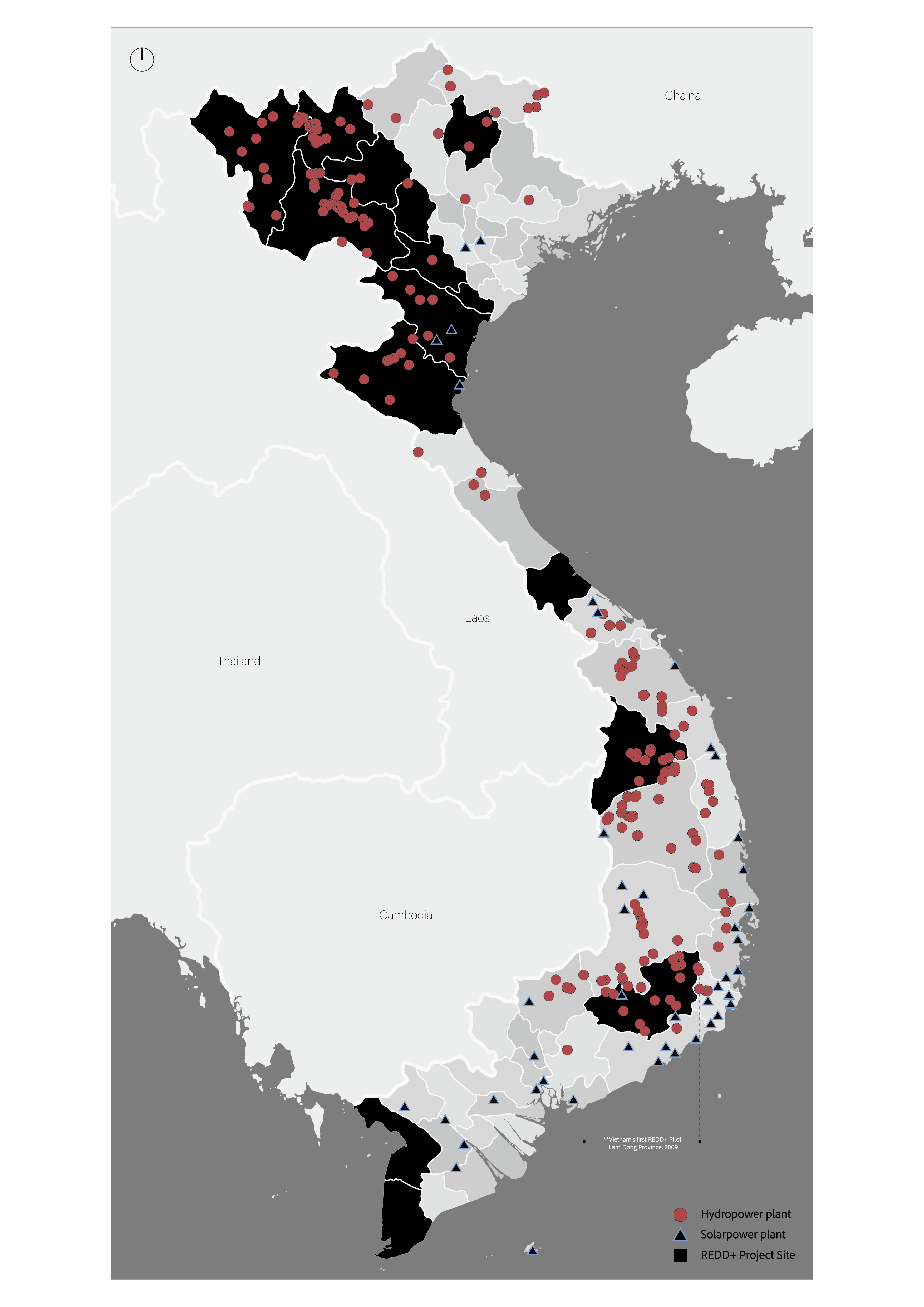
Figure 1: Spatial distribution of REDD+ project sites and energy infrastructures across Vietnam (Yang 2026).
It is also difficult to substantiate the nature of the result-based incentives for carbon emission reductions that are supposed to be distributed to local communities as an outcome of these projects. REDD+ projects have been primarily implemented in the Global Majority countries such as Indonesia, Vietnam, the Democratic Republic of the Congo and Brazil. Vietnam, in particular, was among the first countries to attempt to integrate REDD+ institutionally within a national forestry policy framework (UN 2008; UNREDD Programme n.d.). As REDD+ is predominantly implemented in forest-dependent communities and peripheral rural areas rather than in urban centres, indigenous knowledge of the forest and the long-term participation of local residents are considered key elements in the operation of the offsetting schemes (UNFCCC, 2010). REDD+ projects often refer to local residents as ‘Forest Guardians’, promising to provide incentives for the labour they contribute to forest monitoring and protection activities (UNREDD Programme 2022). A vertical structure was planned whereby a portion of the revenue generated from carbon credit trading would be allocated to local residents (Forest Guardians) who carried out MRV, via the central government, local government and forestry companies.
In the case of Vietnam, however, this model clashes with a land tenure structure whose exclusionary character long predates the socialist system, meaning that the very conditions for participation in REDD+ operate in an exclusionary and segregatory manner. To understand this land tenure structure, it is necessary to trace its historical formation. Land governance in Vietnam can be traced to the large-scale land concentration policies of the French colonial period, which were subsequently carried through the nationalisation and collectivisation of land under socialism. After the 1986 Đổi Mới reforms, these policies gave way to the gradual individualisation and marketisation of land-use rights. As Peluso and Vandergeest (2001) show, the idea of state territorial sovereignty over a category of land called ‘forest’ emerged in Southeast Asia in the nineteenth century, and the production of this ‘political forest’ became a project common to both colonial-era states and the post-colonial nation-states that followed them. In Vietnam specifically, as McElwee (2016) documents, this colonial logic of environmental rule—whereby forest policy served as a mechanism for managing citizens and landscapes rather than ecology—persisted through socialist nationalisation and into the contemporary era of market-based conservation.
This historical transition opened a channel through which international financial institutions such as the World Bank could intervene in the Vietnamese economy. As a result, forests and land came to occupy a contradictory position as both objects of conservation and sites of extraction and capitalisation. In other words, the land-tenure certification system on which REDD+ now relies is not merely an administrative artefact of the Vietnamese nation-state, but also the accumulated outcome of a colonial logic of land governance carried forward through socialist nationalisation and neoliberal marketisation. This genealogy does not stop at the line dividing ownership from use. The same historical accumulation has shaped distinctions between whose labour is recognised as a legitimate contribution to forest conservation and whose labour remains invisible. Legally, all land in Vietnam is owned by the state, and individuals may only ‘use’ land through a land-use rights certificate known as the ‘Red Book’. The problem is that only those holding a Red Book are eligible to be incorporated into the REDD+ compensation scheme. However, Red Book holders constitute only a small fraction of the total local population, and the vast majority of them are men. Even among registered female landowners, many lack independent bank accounts and instead rely on male family members to manage financial proceeds (Phan 2018). As a result, more than 70% of potential participants—including women and ethnic minority communities—are structurally excluded from the legal beneficiaries of REDD+. In practice, economic compensation is concentrated among a small group of male landowners, creating a system where the majority of informal forest users provide labour but are denied recognition of their rights. Beyond exclusion from compensation, REDD+ has in some cases intensified existing pressures on forest land, including forced resettlement, the expansion of logging concessions and the destruction of property belonging to communities without formal title (Ironside, 2017).
Immediately following the introduction of the REDD+ framework in Vietnam in 2009, Lâm Đồng Province was designated as the site for the country’s first pilot project. Various pilot schemes were subsequently carried out there, including the testing of MRV systems, the piloting of benefit-distribution mechanisms under PFES, and the integration of REDD+ with existing forestry governance structures (Xuan Mai Green Technology Trading, JSC, n.d.; EUREDD, 2023). In Lâm Đồng, plans for the construction of the sixth Đồng Nai Hydropower Plant, supported by JICA, were recently suspended following opposition from local residents and a review by the Ministry of Environment. The Đồng Nai River hydropower plant in Lâm Đồng Province is closely linked to the PFES (Payment for Forest Environmental Services) scheme. This was piloted in Lâm Đồng Province from 2008 and institutionalised nationwide through Government Decree No. 99 in 2010 (Vietnam Forest Protection and Development Fund, 2014) and has been operated by the Vietnamese government separately from REDD+. PFES is a national-level forest conservation compensation mechanism that predates REDD+. It was designed in such a way that enterprises benefiting from forest ecosystem services—such as hydropower plants, water supply companies and tourism operators—are required to make payments to local residents who act as guardians. Where payments have been made, they are channelled through provincial Forest Protection and Development Funds and distributed to forest owners. However, with the introduction of REDD+ as a pilot project in Lâm Đồng, international climate finance began to intersect with the existing PFES system, and as a result, the source and criteria for the compensation paid to local residents became increasingly ambiguous. In other words, the compensation actually received by local residents now flows through the existing PFES system rather than from REDD+ funds, resulting in payment delays, uneven distribution along administrative hierarchies, and the continued exclusion of communities without formal land titles (Phuong, 2018). This demonstrates that, when REDD+ operates on the ground, it becomes entangled with the pre-existing PFES system, evading accountability and redistribution mechanisms.
Carbon credits generated in this way through the forestry work of local communities are valued by certification bodies and traded in carbon markets to offset the carbon emissions of multinational corporate giants. Whether in the ESG (Environmental, Social and Governance) reports of these corporations or in the transaction records of carbon credit certification bodies, it remains unclear exactly how many credits were traded and at what price. The determination of the price and value of this global ‘commodity’, designed to mitigate the climate crisis, has now shifted to a system formed in some new and mysterious way. The media merely reports that over 90% of the tropical rainforest carbon offset credits issued by Verra were ‘phantom credits’. Such quiet and uncanny transactions are at once self-referential and conducted in micro-time scales beneath the power structures of large-scale capital. How, then, can we imagine this abstract, hyper-dimensional nexus—beyond the value extracted from labour—between algorithm-based carbon emission prediction models and speculative forms of global capital? To answer this question, we must first turn back to the variable of time. The arithmetic of the baseline examined above, which posits a future destruction that never actually occurs, and converts the non-occurrence of that posited destruction into value, is not merely an accounting fiction, but reveals something about the way capital handles time itself. This politics of time is not unrelated to the genealogy of colonial land governance. The dividing line that governs whose future is entitled to be converted into value, and whose labour is rendered invisible in that very conversion, inherits, intact, a logic of governance accumulated since the colonial period. The following section examines how this arithmetic of absence connects to the broader temporal structure of financialised capitalism—namely, a speculative temporality in which the future precedes and constitutes the present.
Spectral Latency
“Price as such, and value after it, are constituted by and instantiated as différantial pricing wherever and however spontaneously they happen.” (Suhail Malik 2014, pp.776-777)
“Time is changing. We are not just living in a new time or accelerated time, but time itself – the direction of time – has changed. We no longer have a linear time, in the sense of the past being followed by the present and then the future. It’s rather the other way around: the future happens before the present, time arrives from the future.” (Armen Avanessian 2016, p.7)
The functioning of capitalism is not only driven by arbitrage, but increasingly organised around its speculative logic, where price differentials and temporal gaps become the primary sites of value production (Poliks and Alonso Trillo 2025). In the highly financialised stage of capitalism, the price differential-profit structure takes centre stage rather than the production-profit structure. In this sense, the very act of holding onto time in suspension becomes a form of value production. Financial markets, including equities and derivatives, assign present prices on the basis of anticipated future value—that is, a future that has not yet arrived creates the economic reality of the present. Revisiting the issuance mechanism of the aforementioned carbon credits, such credits do not represent a reduction in emissions that have already occurred, but rather signify the postponement of an event expected to occur in the future—namely, the deferral of deforestation. While delay in financial markets refers to the time interval between purchase, holding and resale, the carbon credit issuance mechanism creates a different yet structurally analogous mode of delay. Whereas delay in financial markets arises contingently from the decisions of market participants, the delay built into carbon credits is calculated and designed in advance through the technical device of the baseline. This delay is not a by-product of the market, but a precondition structured in advance for the production of value. The value of carbon credits does not stem from the preservation of forests, but from the time during which the potential for destruction is held in abeyance. In this sense, the Baseline is effectively a mechanism that models a state in which future destruction has been temporarily suspended, converting a deferred ecological future into tradable financial value.
From this perspective, Vietnam is particularly noteworthy as a state that, while shaped by layered histories of colonialism and war, has explicitly adopted a national strategy pursuing both economic growth and environmental governance. Lâm Đồng Province, in particular, is a site that most vividly reveals how the temporality of global carbon governance operates at the intersection of colonial history, socialist statehood, land relations with ethnic minorities and developmentalism. Malik also states: “Complex societies—which means more-than-human societies at scales of sociotechnical organisation that surpass phenomenological determination —are those in which the past, the present and the future enter into an economy where maybe none of these modes is primary, or where the future replaces the present as the lead structuring aspect of time” (Malik 2014, p.8-9). Within the framework of global carbon governance characterised by randomness, this thesis suggests that past colonial forestry discourses, which defined indigenous shifting cultivation as ‘primitive destruction’, are now being transformed into data within the carbon accounting system; satellite data and MRV protocols are replacing the present within the system; and, simultaneously, forests in a state of randomness are becoming collateral for future value.
The Đồng Nai river basin in Lâm Đồng, one of Vietnam’s highest-potential hydropower regions, has long been home to highland ethnic minority communities. Although their history of settlement is estimated to date back several centuries, hydropower development has been accompanied by the involuntary resettlement of local populations and the loss of agriculture land (Dao 2010). It is notable that these overlapping processes unfolded within the same temporal and territorial frame: hydropower infrastructure along the Đồng Nai River began construction in the mid-2000s, the Bali Action Plan of 2007 opened negotiations that would establish REDD+ as a carbon market mechanism, and the World Bank’s Renewable Energy Accelerating Change (REACH) Project—covering Đồng Nai Province among others—has since formalised resettlement as a standard precondition for energy infrastructure development in the region. In its Resettlement Policy Framework for the REACH Project, the World Bank outlined how it had financed Vietnam’s energy infrastructure expansion projects and described how resettlement policies should be standardised in accordance with its institutional criteria (National Power Transmission Corporation 2021). This demonstrates that resettlement has become a fundamental precondition for the operation of climate infrastructure. Within the system, the present lives of residents—lived out in their own bodies—appear only as variables to be managed, while their future is defined as a carbon risk. The spectre of an unresolved past and a future yet to come constantly haunts the present. This is not merely environmental governance, but the politics of time—a speculative field in which past, present and future simultaneously produce one another.
What kind of mode of existence does this structure possess, in which past and future simultaneously constitute the present? It is neither fully absent nor fully present, operating only in the form of mediation, and is in this sense spectral. This temporal structure ordinarily functions as the invisible premise that produces the unit known as the carbon credit, quietly at work until the moment its method of calculation is called into question or the system malfunctions; only then does it become visible. And this invisible operation takes place on algorithmic servers. To think through this temporal structure requires looking into the computing infrastructure in which it is lodged.
Daemonic Loophole
On 19 January 2011, a series of cyber attacks targeted the carbon emissions trading registries across multiple countries, including Austria, the Czech Republic, Estonia, Greece and Poland, prompting the European Commission to suspend all transactions across the entire EU ETS (European Union Emissions Trading System) registry. Approximately 2 million emission allowances, with a market value of around €30 million at the time, were stolen and subsequently dispersed and sold across accounts in various EU member states. The European Commission refused to disclose the details of the minimum security requirements (European Commission 2011). In the Czech registry, no one noticed the credits had disappeared until an employee at an investment firm discovered the discrepancy while checking the inventory the following morning. How could 2 million emission allowances vanish without anyone noticing? This hacking incident reveals the negative aspect of the system’s mode of existence. The internal operational logic of the system remained opaque even to its participants. Opacity was inherent to the very design of the system itself. Paradoxically, carbon credit systems appear to be extremely transparent insofar as they rely on quantification, verification and publicly accessible registries. Does this contradiction—a custodian that conceals what it holds—define the system itself?

Figure 2: BSD daemon illustration by Phil Foglio, originally created as an early visual representation of the Unix daemon and first used on a UNIX T-shirt. Copyright © 1988 Marshall Kirk McKusick, used with permission.

Figure 3: BSD daemon illustration on the cover of the UNIX User’s Manual for 4.2BSD Reference Guide. Copyright © 1988 Marshall Kirk McKusick, used with permission.
In computing, a daemon refers to a process that runs autonomously in the background of an operating system without direct user intervention. The term was first used in 1963 by physicists involved in MIT’s Project MAC (Corbató, F.J n.d.) to describe background processes that operate ceaselessly to perform system tasks, much like Maxwell’s demon. Daemons operate behind the visible interface of the computer, enabling the machine to function in a way that seems entirely natural and self-evident to human users. One early example of a Unix daemon was an autonomous background process that queued print jobs and processed them in sequence. According to the Oxford English Dictionary (1897), ‘daemon’ denoted “a supernatural being of a nature intermediate between that of gods and men; an inferior divinity, spirit, genius (including the souls or ghosts of deceased persons, esp. deified heroes)”. A daemon is both a mediator and a connection without a mediator; its existence is revealed only when the system crashes or malfunctions.
The carbon offset mechanism is simultaneously a daemon in terms of ‘homology of operation’, ‘ghostly visibility’, and ‘intermediary mode of existence’. This mediating mode of existence is not confined to the technical register alone. The logic of governance accumulated since the colonial period likewise operated as something that functioned seamlessly only so long as its source of authority went unquestioned. A daemon operates similarly. The baseline in REDD+ is constructed by back-calculating future data by people who are not present on the ground. It is an algorithmic calculation carried out in real time within units of microtemporal scales, outside the phenomenological time of local communities. At the same time, it is a daemon in that it hovers somewhere between reality and abstraction, mediating both yet belonging fully to neither.
Let us now tear open this overlapping aperture to gaze into the eyes of the invisible ghost. Intervening in this system’s unpredictability, its elusiveness, absence and opacity. Coexisting with the invisible. And to become aware of the distance from it, or of the distance-absence.
Post-representational counter-mapping through unlistening

“In this expectation, I practise a new listening and therefore generate a new hearing of what appeared obvious before. This is not the gap that language assumes, but the gap that prepares listening. It is an obscure gap not illuminated by words, but tended to in the darkness of the contingent and private anticipation of the écoutant. It is the place of sound, where it gurgles in anticipation before it blurts out.” (Salomé Voegelin 2010, p.98)
The detuning referred to in the title of this research is not a mere metaphor. Pitch is the measure of how closely the frequency of a tone coincides with, or deviates from, a standardised reference, such as the concert pitch of 440Hz, and is thus essentially an act of measuring deviation from a ‘baseline’. According to Gribenski (2023), even this standard of 440 hertz was not given naturally or neutrally, but was a product constructed through scientific and political negotiation across the late nineteenth to mid-twentieth centuries. In this sense, pitch resonates structurally with the way REDD+ establishes its baseline. Both generate value or meaning only through deviation from a pre-agreed reference, whether an unrealised future level of emissions or a standardised frequency. Just as the price of a carbon credit is calculated as a deviation from the baseline, pitch too is identified as a deviation from a standard frequency. Detuning refers to the act of intentionally drifting away from this standardised reference rather than remaining within it, and resonates with the methodological stance this research takes in seeking to detect what lingers outside the standardised measurement systems of the carbon market. In this sense, the sound this research engages with is not limited to the domain of auditory experience. It is also a structural tool for thinking through the way price and value are established.
According to Voegelin, sound is not a medium of representation but of presence. Carbon credit issuance and trading systems render the immanent carbon of forests into numerical values and translate residents' actions into risks. What this system fails to capture is this dimension of presence: the unquantified living it claims to measure, which remains untranslated, arriving now, before us. For this reason, I turn to the act of listening to explore the fissures inherent in this abstract structure. Listening is not merely an auditory act, but an act of sensing and detecting the tremors and fractures of power that operate within regimes of surveillance. Vibration functions as a performative practice that mediates the ethical tension leaking through these cracks using the language of sensation and affect. Drawing on Voegelin's argument, it is a matter of practising ‘listening in’ rather than ‘listening to’, thereby forming a subject of listening that is ‘complex, sticky and involved’.
Whilst Voegelin frames listening as an engagement with the present, Fred Moten locates it within a structure of institutional reduction. Sound–what he calls ‘phonic matter’ (an exterior aurality irreducible to meaning)–is rendered ancillary and external, even as it resists this reduction (Moten 2003). This implies that sound is not simply an object of perception or representation, but exists under conditions in which it is selectively captured or excluded by institutional systems. For Moten, captured sound is ‘the remainder as well as the rupture’ (Moten 2003). What is carried through the sound can never be lost but only irrevocably ‘given in transit’ (Harney and Moten 2013, p.51). It can only be sensed, and persists solely through relational encounter–what he calls ‘hapticality’ (Harney and Moten 2013).
The sounds employed in this research are not recordings collected from the field. Rather, the frequency values were extracted from a standardised technical database. In doing so, the research structurally reproduces the very logic of the system it seeks to critique; it both critiques and performs such isomorphism. Instead of reconstructing or representing sound, this constitutes a deliberate withdrawal from dominant sensory regimes; a methodological choice that seeks to foreground the conditions of what remains uncaptured. As such, this system does not listen. It detects a daemonic loophole in the site of loss, where sound has ceased. This silence is not mere emptiness, but a call for listening directed at contemporary recipients.
Through this format, I interrogate the structural conditions within which this research is situated. Within the invisible international infrastructure of carbon offsetting, whose voices are heard? What is omitted? Which vibrations are articulated and concealed? And from what distance can I sense and transmit them?
Conclusion
This research has unfolded across three registers of argument. The first concerns the way REDD+ baseline-setting assigns value to something that never actually happens. This is a future destruction held in suspension such that the carbon credit becomes not a record of reduction but a wager on deferral. The second register traces how this logic of speculative valuation is not merely a technical artefact but continuous with the broader temporal architecture of financialised capitalism in which the future precedes and shapes the present. It also traces how that same architecture has been laid over and become entangled with Vietnam’s longer history of colonial and post-colonial land governance. The third register turns on a structural homology: a system that generates value only through deviation from a pre-established baseline that operates, at the level of sound, in the same way that pitch is identified, that is, as a deviation from a standard frequency. To intervene in such a structure, the language of standardised measurement is insufficient; what is required instead is the acoustic methodology of detuning and unlistening. These irreducible registers yet converge on a single question: who holds the authority to render the invisible visible, and to quantify it?
This research concerns a language I have never spoken and a land I have never lived in. Nevertheless, it adopts that distance and intermediary position as its methodological condition. Things I cannot access and subjects I cannot question are the limitations that have determined the methodological position of this research. The sound methodology this research adopts arises from the same position. The choice not to pretend to hear what I cannot hear, and not to speak in place of others, runs through this research. Within this gap, I have sought to trace how invisibility, unrecorded temporalities that continually intervene in the present, and entities outside the system come to constitute reality. The structure of invisible power that operates in the process of converting immaterial value into exchangeable units determines what can be made visible and what ultimately remains. However, rather than elucidating how this power acquires legitimacy, this research aims to reveal the conditions that prevent such questions from being adequately raised in the first place, that is, the structures that keep certain things from being articulated. For this reason, the sites where I gaze upon and linger are not facts that have already been made visible, but rather the layers that continue to operate while remaining unspoken. These entities can be said neither to be fully present nor fully absent, and it is precisely for this reason that this research seeks to conceive of them not as fixed objects, but as states that continuously slip, misalign and permeate.
I believe, rather, that new possibilities emerge within these incomplete gaps, imprecise boundaries and indeterminate positionalities. To accept the suffering of another who does not resemble me as a sensation that cannot be fully separated from my own life, while standing at the boundary and imagining what lies beyond it: this is the ethical stance this research takes. In this sense, this research is not merely an indictment of the carbon market. I am interested in probing why certain information is structurally designed to remain invisible, and why certain sensibilities are marginalised, rather than seeking clear answers.
Ultimately, this research is an attempt to dismantle structures I once fully believed in, or never even doubted, and to forge new relationships with the invisible within their remains. This research does not converge toward a single conclusion. Rather, it remains an opening toward other possibilities. Through this imperfect assemblage of architecture and sound, policy and metaphor, emotion and material, I will continue to pose questions.