


Countermapping offers an alternative way of imagining the world and our relationships within it. It is not only a critique of dominant systems of mapping and knowledge production. Countermapping is a method, modality and practice that shifts away from colonial cartographies and toward relational, place-based and life-affirming ways of knowing. It celebrates our resistance and enlivens our collectivities, which are interconnected networks of humans and more-than-human beings, emphasising relationality. This approach recognises that we exist within reciprocal relationships with the living world. It is a way of being proactive rather than reactive to the long-stemming challenges in our shared environment. This is where colonial and extractive mapping no longer serves as the starting point. Beginning with colonial maps inevitably reproduces their limits and omissions, as they are shaped by extractive logics and systems of power. Each time we rely on the colonial archive as our primary reference, we risk reinscribing its borders, reaffirming its absences and reproducing the worldviews it was designed to uphold. Countermaps, knowledge infrastructures and the communing of resources are archives of resilience that are grounded in care and connection.
Digital somatics and ocean-sensing, as liberation-based counter-mapping methods, configure the body and ocean as an ecosomatic interface countering extractive intelligence. Extractive modalities of data, infrastructures of surveillance and domination are life-ending, hope sucking and uninspiring. These are carceral enclosures where dystopia is presented as inevitable, actively foreclosing any present or future possibility where our collective liberation can be imagined, let alone shared. Our pasts are projected onto through a lens of scarcity and then that approach is internalized in the present and towards the future as a precarity that is never-ending. This nihilistic framework produces fear that permeates our bodies and society in every sphere. We fear speaking up, standing up for ourselves and expressing sadness or anger. We self-monitor, learn how to obey and fall in line. Effectively, we have a police officer in our heads that informs us that a better world is not possible and polices our imagination. We internalise systems of domination that police the boundaries of what we believe is possible and limit our capacity to imagine alternative worlds. bell hooks reminds us that practices of love and care become radical acts that resist this control (hooks 2000, p. 4). Robin D. G. Kelley argues that liberation depends not only on resisting existing structures but also on cultivating the radical imagination to envision alternative futures (Kelley 2002, pp. ix–x). Similarly, Paulo Freire contends that liberation requires recognising and overcoming internalised forms of oppression, as the oppressed often internalise the consciousness of the oppressor and must critically transform this condition through praxis (Freire 1970, pp. 43–47). To transform the broader societal status quo, we must first contend with the patterns, beliefs and histories held within our internal worlds, engaging them through embodied, somatic practice. In doing so, we transform the way we relate to ourselves, to one another and to the more-than-human world. This process disrupts the internalised structures that reproduce the status quo and instead cultivates the conditions for a more liberatory collective imagination.
Moreover, this form of internalised fear not only separates us from each other and a greater sense of the collective, but it also separates us from our environment. We see the trees, water, soils, and rocks not as living beings but rather as ‘materials’, from which we extract financial value. Herein, land and water are privatised, owned by multinational conglomerates. Against the idea of collective care and reciprocity, this extractive logic dehumanises our shared world. It belies a concept crucial to our survival: that, as living beings, we are not separate from our environment. The insides of our bodies are deeply connected to the outside; our skin, blood and bones are porous membranes. When carceral logic is swiftly deployed externally, we also deploy carceral logic on ourselves internally. We need to shift this way of being by mapping a more abundant framework, one that enlivens, countermaps and builds an unshakeable foundation of hope, resilience and care.
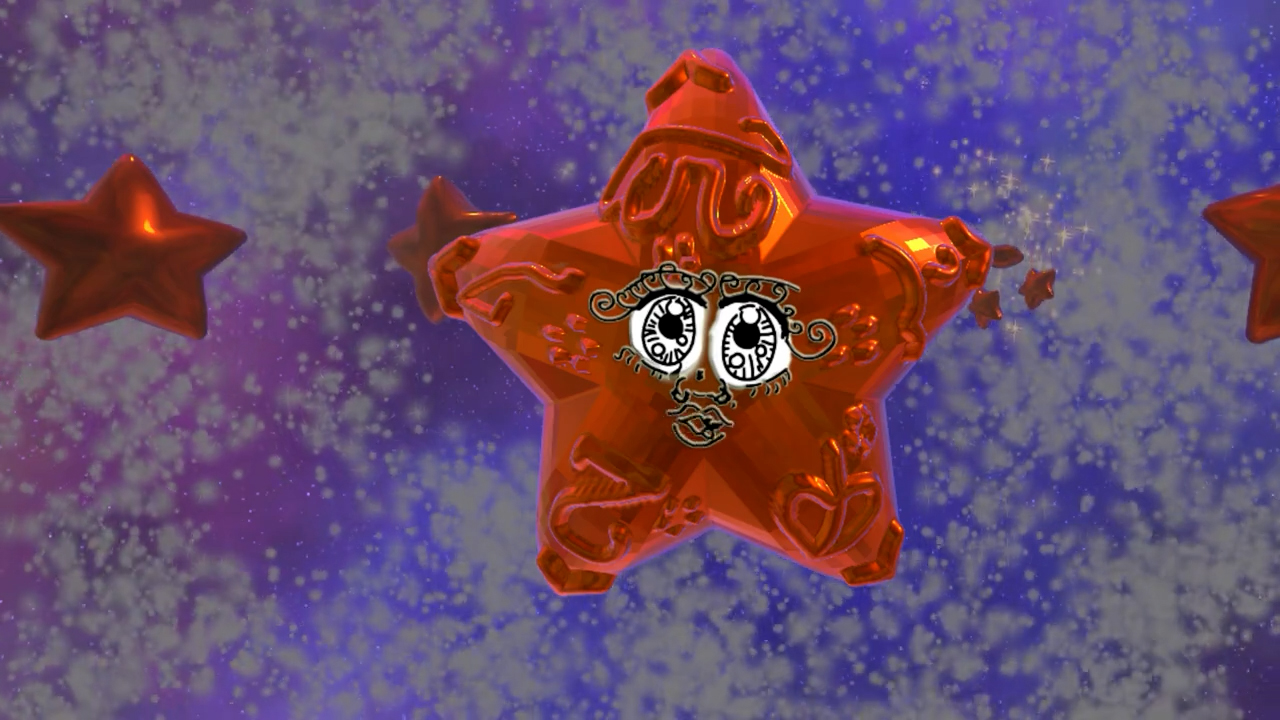
Figure 1: Lullabies for tears, VR Still (Ali 2024-2025).
Countermaps of eco-somatics
Contemporary narratives surrounding artificial intelligence often encourage us to perceive technology as more animate, intelligent or ‘alive’ than the waters, ecosystems and landscapes that sustain life. An ecosomatic approach challenges this hierarchy by reorienting attention toward the vitality, agency and intelligence of the more-than-human world. Ecosomatic is “a multidisciplinary area of practice and research that connects somatic practices in dance, movement, performance studies, and disability cultures with ecological attunement or awareness” (Enghauser 2007, pp. 80–88.; Fraleigh and Riley 2024, pp. 4-8). It builds from Astrida Neimanis’s term hydrofeminism, where she shares that, “We are all bodies of water.” This points to the water we carry in our bodies, as human bodies are at least 75% to 55% water, and dismantles the idea that we are separated from the environment, as our human bodies are bodies of water, connected to other bodies of water (Helmenstine 2024). We are forever intertwined with our bodies with the environment (Neimanis 2012, p. 99). Astrida Neimanis’ seminal essay informed the feminist studies and the hydrological imaginary of the 100 Words for Water: A Projective Ecosocial Vocabulary (2025) book. The book brings together key terms from the interdisciplinary fields of science, philosophy, politics, activism and architecture to examine the contemporary climate crisis. It argues that "the climate crisis is mainly a water crisis," reframing environmental challenges through the lens of water and its central role in sustaining life...” (UN-Water 2019; Franch i Gilabert, Luzárraga and Muiño 2024, p. 10). This means that access to water is a crisis, and so are our bodies, our societies and the larger collective. Guided by Black feminist, Indigenous, African and decolonial methodologies linking spirit, science and storytelling, we need to proactively countermap towards expansive imagination for liberatory presents and futures (Neimanis 2017, p. 109). In Tara Roberts’ book, Written in the Waters (2025), she combines personal and cultural history towards tracing the global slave trade through scuba diving. Ehime Ora’s Spirits Come from Water where Ora, Ifa and Orisa priestess, share her approach to ancestral veneration through hydrology. Similarly, Leanne Betasamosake Simpson’s Theory of Water, guided by Nishnaabeg stories of Nibi, considers water as a source of relation and connecton. As Simpson writes, “Water droplets in our breath connect us intimately...” (Simpson 2025, p. 16). This understanding aligns with Toni Morrison’s declaration that “water has a perfect memory and is always trying to get back to where it was” (Morrison 2003), and is also explored in “Sounding the Ocean: Spiral Networks of Remembrance and Elation” (Ali 2026). Even at the edges of water, in the littoral, shoals or brackish waters, we are called to witness the in-between of Tiffany Lethabo King’s The Black Shoals, where the shoal, an offshore geologic formation that is neither land nor sea, is metaphor, mode of critique and methodology. This in-between formation is used to theorise the connection between slavery, anti-Blackness and Indigenous genocide’s structure within white supremacy. Another critical mapping of watery landscapes is Jesse Birch and Will Holder (Eds.)’s Brackish Waters, where brackish water, a mixing of salinity level between freshwater and seawater, is a metaphor for crossing oceanic worlds of extraction and distribution of artists, writers, Indigenous Elders, fish and fishers, biologists, citizen scientists, whales, physicists, boat builders, ship workers, sailors, pirates, brittle stars and other beings of the deep (King 2019, pp. 1-3; Birch and Holder 2025, pp. 5-9).
Due to extractive logics of algorithmic systems, we can feel like we stand alone; however, through an ecosomatic method, we can realise we are never alone; the land is with us, our ancestors are with us, the water is with us. “An ecosomatic approach encourages an embodied relationship with the more-than-human world by cultivating sensory awareness and recognising the body as a site of ecological connection. Through attention to perception, movement, and lived bodily experience, ecosomatic practices invite individuals to understand themselves as interconnected with broader ecological systems rather than separate from them” (Abram 1996, pp.45–52; Merleau-Ponty 1962, pp.143-146) and the world around us. When we practice an ecosomatic approach and methodology, we realise our deep connection to the world around us. Our bodies are connected to the water and our environment; our bodies always hold water. With this realisation and bravery, we can confront the internalised ‘cop’ in our heads, dismantle internalised surveillance infrastructure and broaden our abilities to imagine with abundant liberatory possibilities.
Countermap of dreaming
While ecosomatics grounds us in the sensory experience of the present environment, dreaming extends this embodied awareness into the unconscious, offering a space where imagination, memory and ecological relationships can be explored beyond the constraints of waking perception. Dreams are spaces where imagination is projected, transformed and refracted. They are also political territories, where the external limits and structures imposed by society can become internalised within our subconscious. Radical dreaming offers the possibility of moving beyond these constraints, creating space to imagine alternative futures and engage in acts of world-building oriented toward liberation. Dreaming Communities is a series of workshops and lectures that explores how dreams can ignite our imagination. Dreaming Communities brings together dreamers and people interested in emancipatory practices to explore dreaming as a collaborative and imaginative method. Together, we catalyse dreams as inspiration to build a collective 3D collage using Blender, an open-source 3D animation program, and New Art City, an open-interactive world platform. Drawing on contemporary digital art, Afrofuturism, speculative fiction and critical theory, we engaged with the work of Octavia Butler, Sayaka Murata, Annika Hansteen-Izora, Tabita Rezaire, Ruha Benjamin, Refik Anadol, Ursula K. Le Guin, Morehshin Allahyari, Legacy Russell, Carolyn Lazard and The Hyphen-Labs Collective. We treat dreaming as a communal act of world-building, crafting digital portals of possibility grounded in accessibility and disability justice. As part of the conclusion of this series, participants design immersive spaces that reflect our collective vision in a spirit of discovery, connection, and play.
The territory of the imagination needs to be excavated and emptied of surveillance rhetoric. During the rise of 45’s1 second presidential term in the United States in 2025, I led Dreaming Communities, a world-building and digital storytelling course using 3D technologies.The students were deeply dismayed during this iteration of the course. Understandably, they were part of the generation who graduated high school online during the COVID-19 pandemic and were under the aforementioned individual’s second term. One student said, “I can’t dream of a different world, a better world, because I am so tired of the current one; I am emotionally exhausted.” I responded, “Well, we don’t need to imagine a better world right now; we can stay with the feeling, the tension we feel now and visualise that, give it a place to be felt and not deny the hopelessness.” To put that sentiment simply, sometimes when we feel lost and depleted, instead of forcing ourselves to find a way out immediately, we need to stay with that feeling of tension and the discomfort that it brings so we can feel and release it. This is the crux of what Dreaming Communities is about—using our imagination as a wayfinding tool, a countermap towards a more liberated present and future, and we get there by confronting, addressing and recognising the current challenges to our collective landscape. This process allows us to find the will to collectively dream again.

Figure 2: World-building still from Dreaming Community: Immersive 3D World Building in New Art City, Hosted by Powrplnt, New York City, NY (2026).
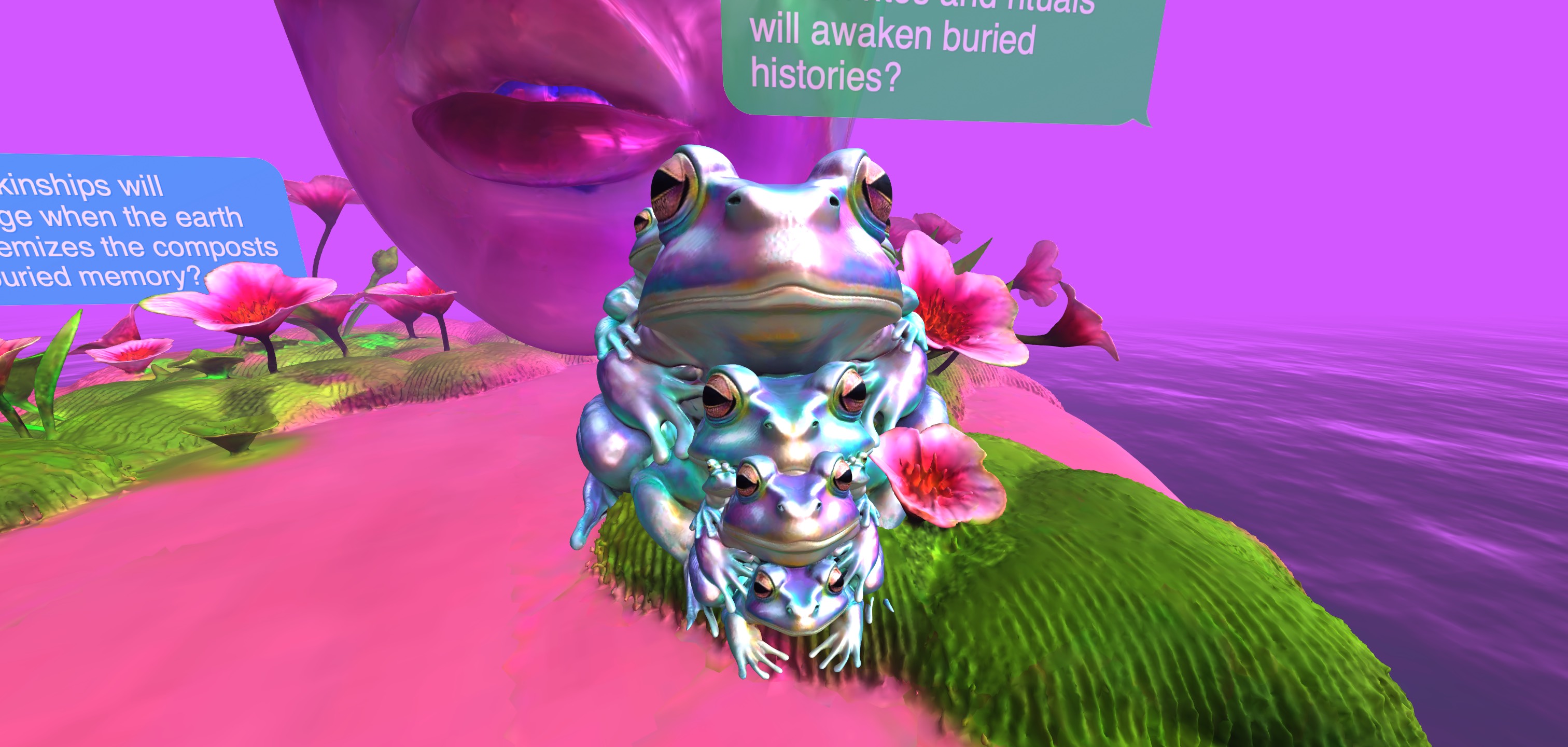
Figure 3: Student work from Dreaming Community: Immersive 3D World Building in New Art City, Hosted by School Of Making And Thinking, New York City, NY (2026).
This workshop series has undergone several iterations and revisions, and over the years, as a convener and educator, I have been amazed at the power of imagination and play. It is a truly radical practice of dreaming that is life-affirming and hope-building and offers a countermap from which to live more freely and connect to the vast universes unfolding around us–a call to tune in deeper to our dreams, bodies and environment.
Counter map of Ocean-sensing
Ocean-sensing is an immersive, somatic and durational practice of listening—not as metaphor but as methodology.
We enter a process of transmogrification: from vibration to matter, from plasma to volcanic ash, from ash to water, from water to relation.
Ocean time is non-linear and recursive—tidal rather than progressive—after Kamau Brathwaite (Brathwaite 1984, p. 64).
To listen, here, is to attune with the body—to feel texture, pressure, resonance. The ocean calls with splendour and sorrow, abundance and degradation.
Listening becomes ecological and ancestral accountability—a call to channel the ocean.
“To listen, in the context of ocean-sensing, is not simply to hear; it is to attune somatically, to feel the textures of water through the body, mind and heart. The ocean’s call is both splendour and sorrow, abundance and degradation. It asks us not only to witness its beauty, but to reckon with its pollution, its extraction, its pain” (Ali, forthcoming). This is important, as in order to feel more deeply connected to the world around us, we must also somatically feel pain and be reminded of the current challenges of our shared cultural landscape, to name a few: war, climate crisis and genocide.
Ocean-sensing builds from Kamau Brathwaite’s term tidalectics, which is a non-linear, recursive movement of ocean tides as a counter to unilateral historical progression and builds on traditions of listening as an embodied, ethical act (Brathwaite 1984, p. 64). Dylan Robinson’s concept of hungry listening critiques extractive modes of reception that prioritise information over relation, capture over care. He writes, “Hungry listening prioritises the capture and certainty of information over the affective feel, timbre, touch and texture of sound” (Robinson 2020, p. 2). Listening becomes a means of power: who gets to be heard, who listens and who is reduced to data (Ali, forthcoming).
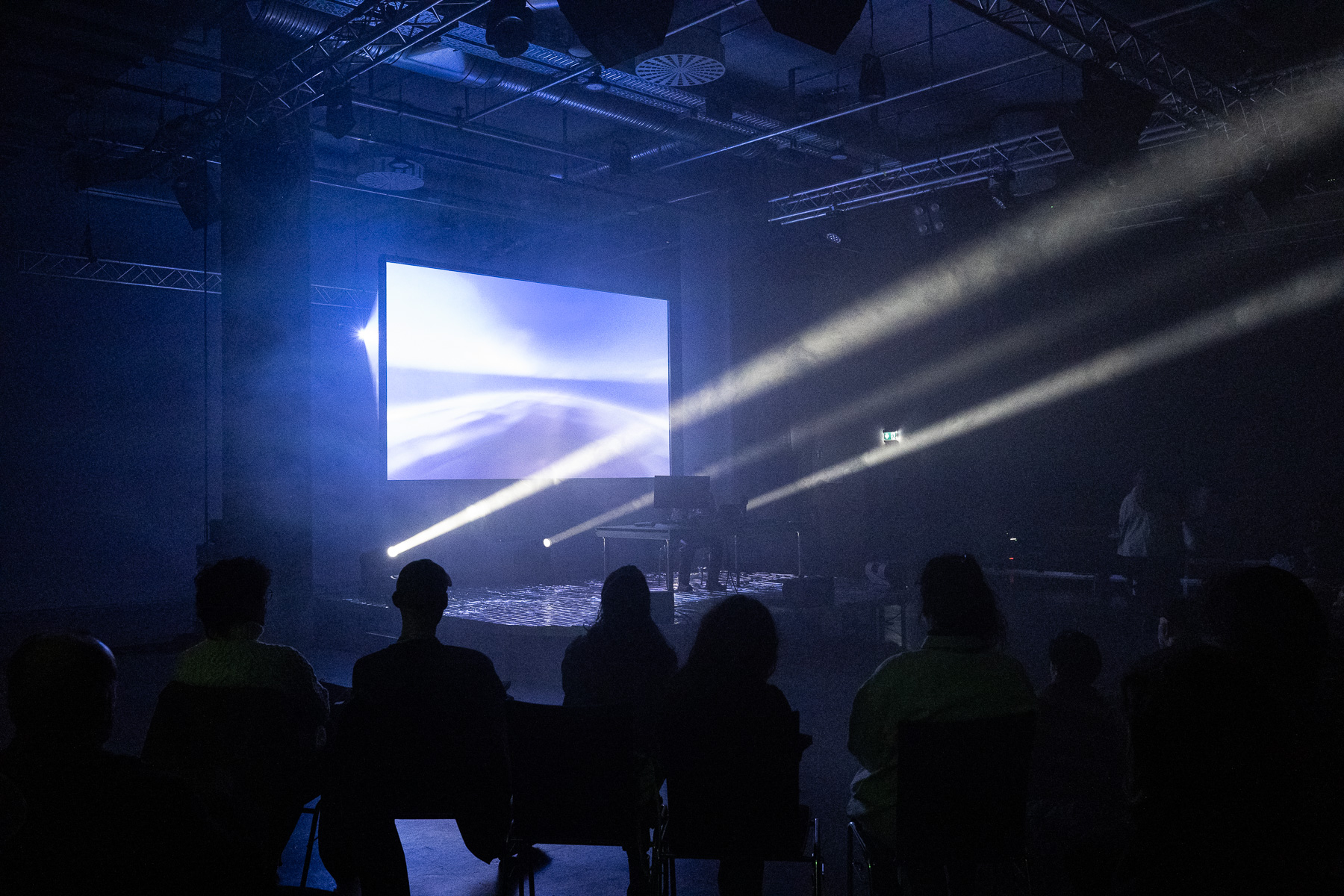
Figure 4: Sounding The Ocean: Spiral Networks Of Remembrance and Elation, lecture performance at Transmediale 2026 (Ali and Pflügel 2026).
In my performance, Sounding the Ocean: Spiral Networks of Remembrance and Elation, participants experienced ocean-sensing, an immersion that reorients our senses, bodies and the way we move (Ali 2026). I invited audiences into processing what it might feel like to be in a different oceanic being—be it a snail, a mussel, a clam or a sea eel— with the following prompt:
Ocean-sensing is a process where we, as listeners, undergo a process of transmogrification:
- from vibration to matter,
- from plasma to volcanic ash,
- from ash to water,
- from water to relation.
To listen, here, is to attune with the body—is to feel:
- texture
- pressure
- resonance.
Ocean sensing asks: what if intelligence were not a system of capture, but a current of relation? What if sensing were an act of care?
This performance-lecture, rooted in the Swahili Seas and Indian Ocean world, comes from a larger body of work; in addition to being a performance-lecture, it is a video game and virtual reality documentary that investigates intangible cultural heritage across sound, architecture and embodied memory. Working across immersive documentary methods, spatial audio, and narrative worldbuilding, the project traces Swahili, Coromandel Coast, and Gulf musical and architectural lineages as living systems shaped by migration, devotion, trade, and exchange. The project draws from research conducted in Zanzibar at the Dhow Countries Music Academy, Hyderabad and Chennai, South India and across Riyadh, Saudi Arabia, where sound operates as both archive and social infrastructure. These encounters inform an expanded documentary language that treats music and built environments as interconnected mnemonic technologies rather than static cultural artefacts.
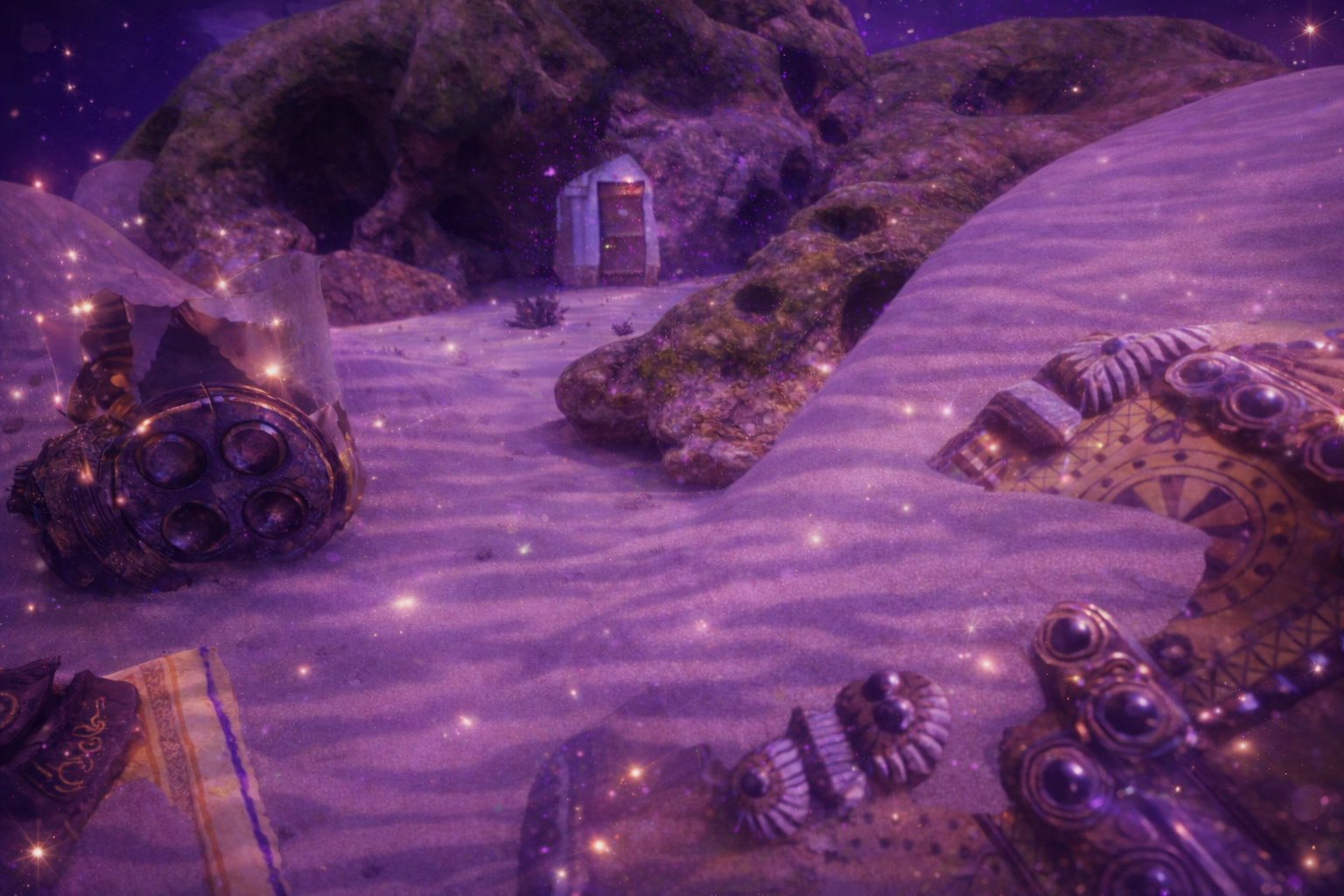
Figure 5: Spiral Networks of Remembrance and Elation, virtual reality documentary/video game still (Ali 2026).
Through VR and video game exploratory environments, spatialised sound and nonlinear narrative structures, Spiral Networks of Remembrance and Elation explores remembrance not as fixed history, but as a relational, embodied process activated through listening, movement and place. In the performance, I embody volcanic ash, plasma and oceanic eruption, modelled after Hayli Gubbi, a volcano in Ethiopia’s Afar region. I sing through a voice modulator in the microphone, with music from Chema Bent Hammoud, Daq El Hub, shared by Maqam.tv and Vugo Matondoni, uploaded by Suleiman Mohammed (MSN Weather 2026; Mohammed, n.d.; Maqam.tv n.d.). I use the Sensei plug-in with Ableton, lecture slides, water and contact microphones to trigger live projections while I sing into the microphone. When Hayli Gubbi erupted last year, it disrupted flight patterns across East Africa, India and the wider Indian Ocean region, pointing once again to the shared landscape of atmosphere and climate. As part of the musical performance, I reference: Taarab, a musical tradition from the Swahili coast blending Arab, African and Indian influences, featuring instruments like oud, qanun, violins and percussion; Fjiri, traditional music of the Bahrain and Gulf pearl divers, which is performed by men with drums, clapping and call-and-response singing; and Jalatarangam, an Indian classical instrument made of ceramic or metal bowls filled with water where the pitch is controlled by water levels to produce delicate, bell-like, fluid sound. Mixing these music genres live with my performance is my interpretation of ocean-sensing. It creates an immersive sonic environment where the fluid sonic architecture moves through listeners' bodies in a meditative and somatic manner.
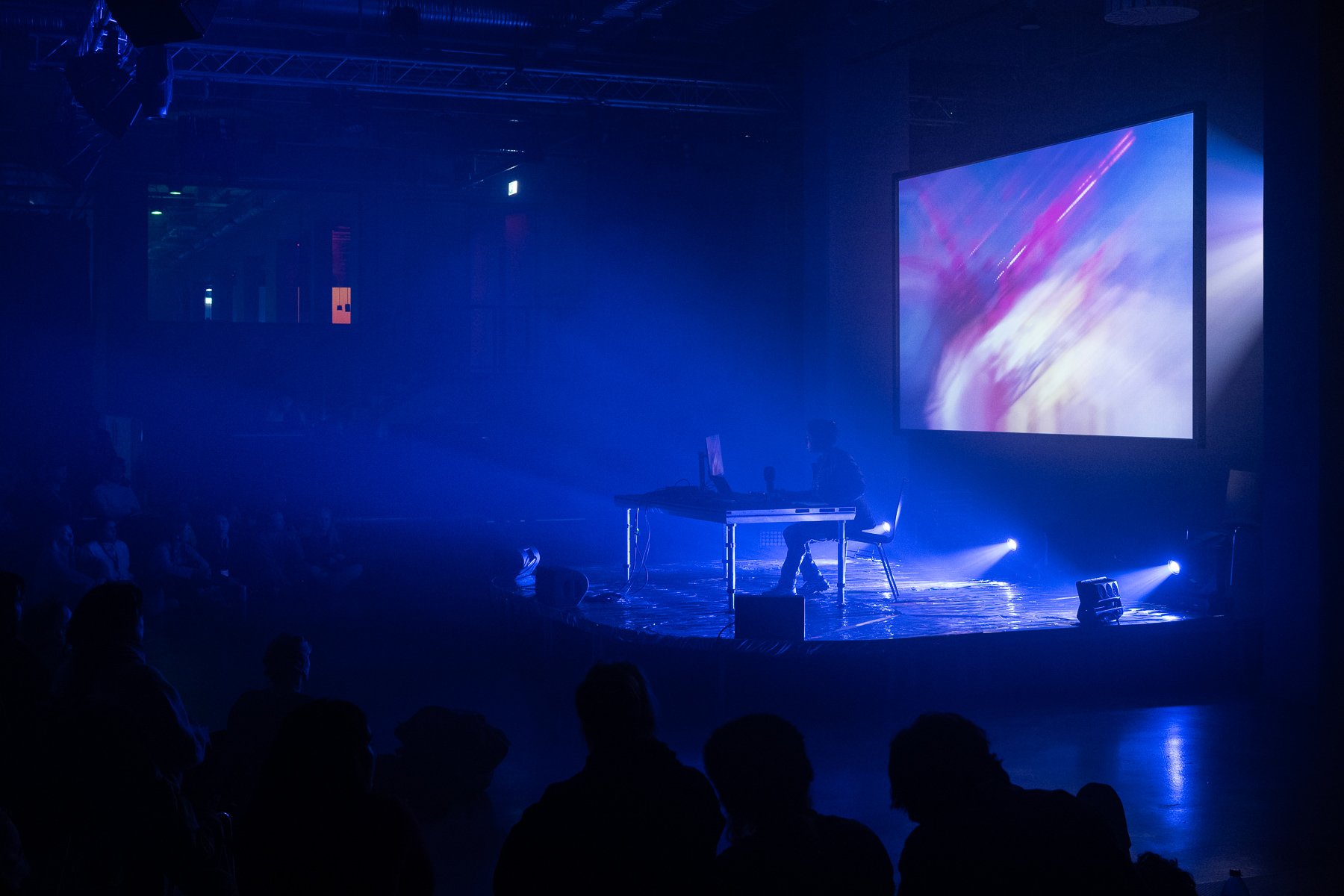
Figure 6: Sounding The Ocean: Spiral Networks Of Remembrance and Elation, Lecture Performance at Transmediale 2026 (Ali and Pflügel 2026).
Ocean-sensing as a countermap through sonic architecture is part of my ongoing practice and comes from earlier work with the sound of the Indian Ocean Mixes (Ali 2020) series. This series engages the shared cultural and sonic heritage of the Indian Ocean world. The first episode examines the role of the مقام / maqam, tracing its resonances from the Arabian Peninsula across the broader Indian Ocean region and considering how musical form carries, mediates and reshapes cultural identity through processes of movement and exchange ( Touma, 1996, p. 38). The second episode features Nada Sayed of the Substack, House of Lolia, and focuses on Zar—ritual practices of spirit possession and healing found in Sudan, East Africa and across the Persian and Arab Gulf. These practices are situated within wider histories of migration, trade and spiritual cosmologies across the region (Sayed-Ahmed Atieg 2023). A third episode, currently in development, turns to fjiri music and the sonic traditions associated with Gulf pearling cultures. The series began in 2020 on Montez Press Radio through Sparkle Nation and was later reissued as a monthly broadcast on Radio Al Hara (Ali 2020).
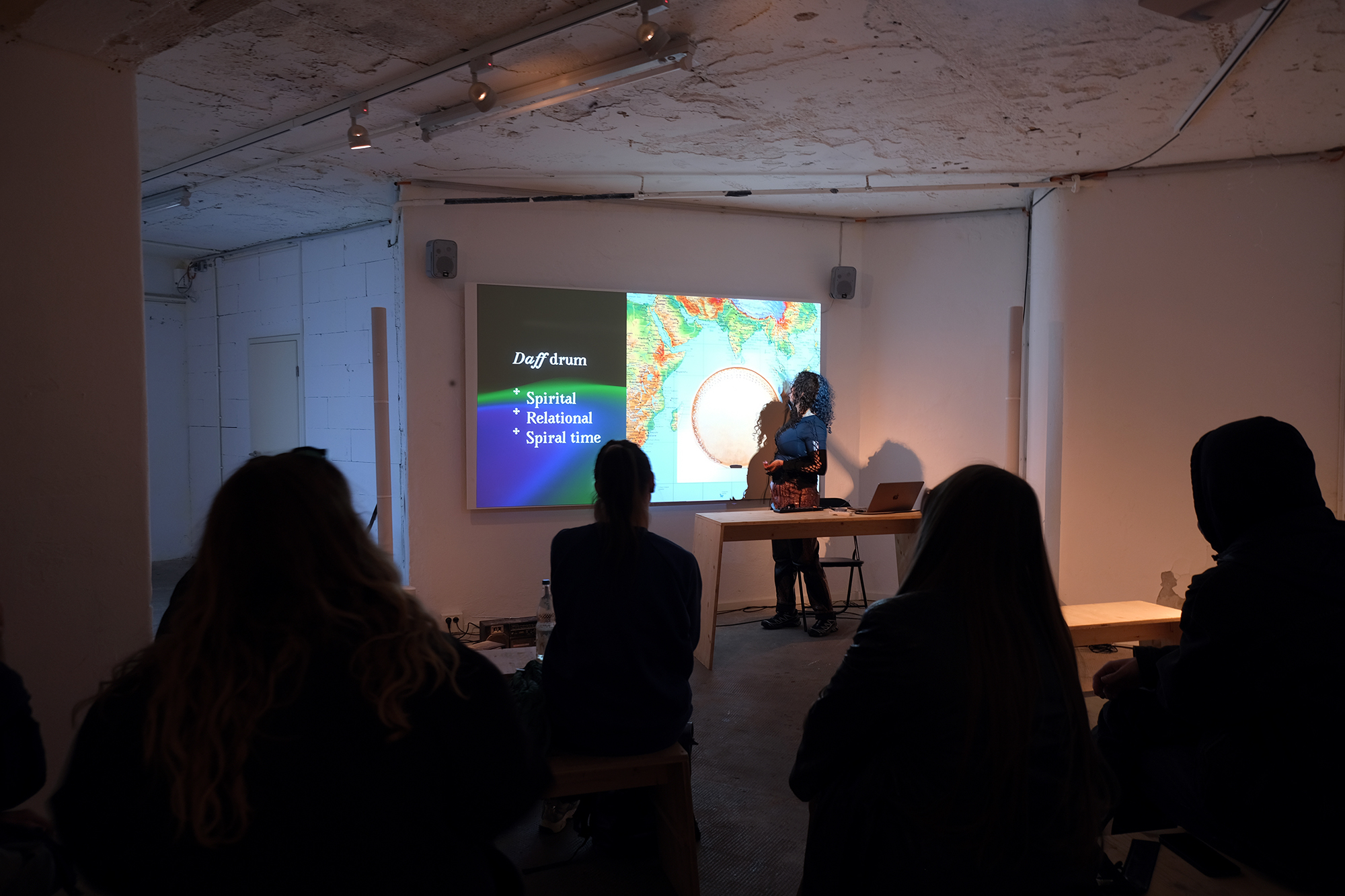
Figure 7: Zaman/i/a: Tuning Time through the Swahili Seas, Performance Lecture, A Broken Clock Is Right Twice A Day Exhibition, Projektraum Romerstasse (Stuttgart) curated by Lukas Beyer, Matilde Outerio and Kristina Miller (Ali and Outerio 2026).
Recently, I debuted a sound performance titled Zaman/i/a: Tuning Time through the Swahili Seas, which visualised a Zamani sense of time. The work draws together Zamani (Swahili), Zaman (Arabic) and Zamana (Urdu/Hindi), words sharing a common linguistic root that resonate across Indian Ocean worlds. Rather than marking time as a linear progression, these terms suggest a layered temporality in which past, present and future circulate together.
Within this constellation, Zamani evokes a deep temporal ocean beyond individual memory: a reservoir where histories gather and reverberate. At the centre of the performance is the daf, whose circular frame drum becomes both instrument and cosmology. The work approaches this oceanic sense of time through sound, repetition, vibration and return. Drawing on archival and field recordings from the Indian Ocean world, fragments of voice, rhythm and environment are woven into looping sonic structures. Across devotional and communal musical practices of the Indian Ocean, the drum often serves as a medium of collective remembrance and spiritual attunement. Here, its resonance becomes a way of tuning time itself. Through layered rhythms, resonant strings and archival echoes, the performance imagines a ‘Swahili Seas’ sense of time, tidal, cyclical and spiritual, where sound carries memory across oceans, generations and moments of eternal return.
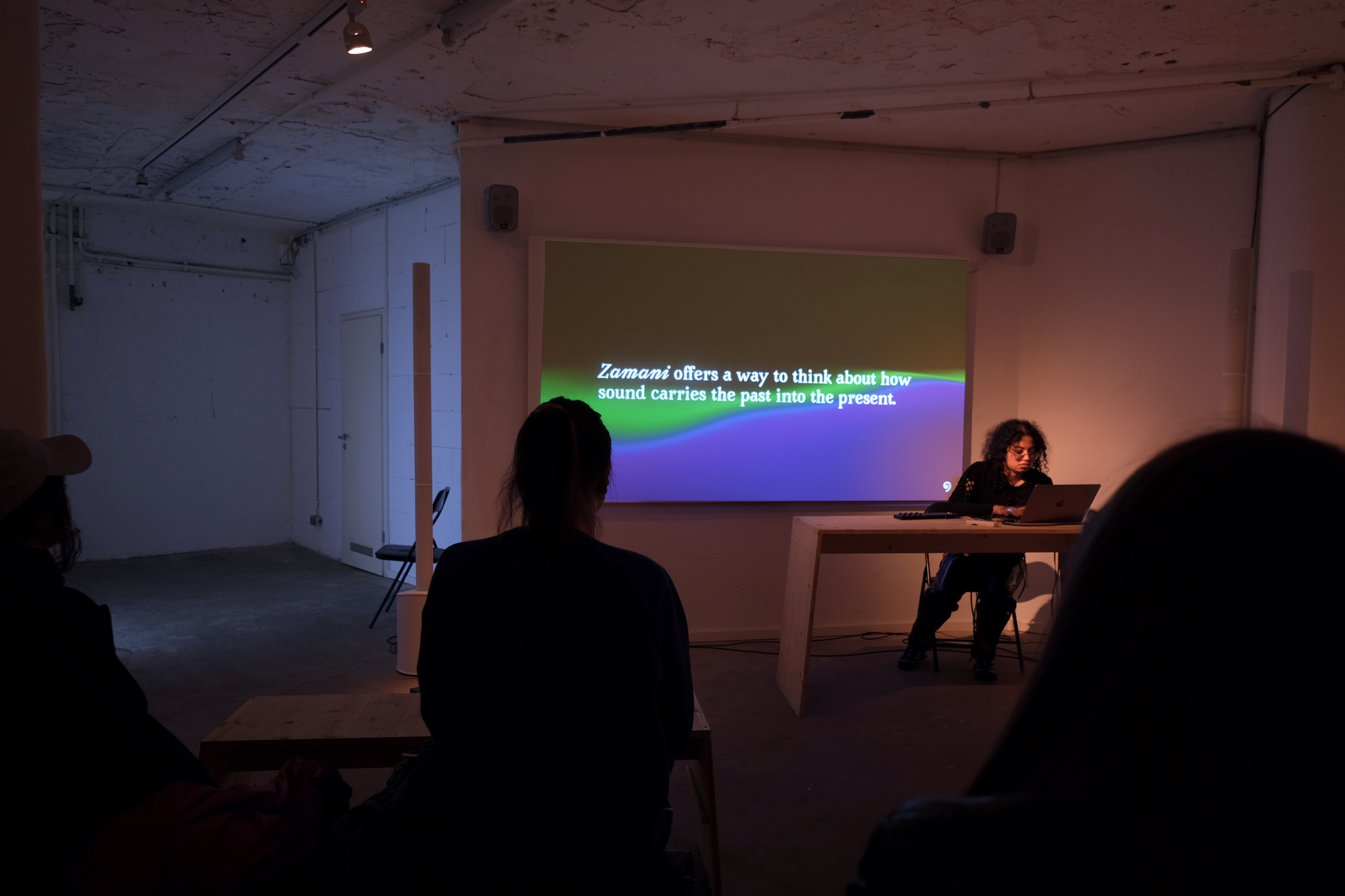
Figure 8: Zaman/i/a: Tuning Time through the Swahili Seas, Performance Lecture, A Broken Clock Is Right Twice A Day Exhibition, Projektraum Romerstasse (Stuttgart) curated by Lukas Beyer, Matilde Outerio and Kristina Miller (Ali and Outerio 2026).
This is an ocean-sensing approach that understands water as both archive and collaborator: a medium that remembers, dissolves and reconstitutes knowledge. To sense with the ocean is to unlearn the separations between body and machine, land and data, surface and depth. The alternative and mainstream modality, where AI and data infrastructures mine, measure and enclose, that we are currently immersed in is no longer a present we want to live in. Instead, the practice of ocean-sensing invites us to listen, breathe, unfold and to imagine our wild, wilder and wildest dreams as an imaginary, which “refers to collective projections of a desirable and feasible future” (Benjamin 2024, p.vii).
Expanding our capacity to imagine a more liberatory future questions wider society’s pervasive sense of dystopian inevitability and quietens the internalised ‘cop’ that restricts our imagination. We are engaging in productive trouble-making as Benjamin shares, “And, if imagination can lead to troublemaking, is it any wonder, then, that those in power work tirelessly to squash us from having radical imaginations that dare to envision a world in which everyone can thrive?” (Benjamin 2024, p.vii). Ocean-sensing offers us, as such, a somatic and relational practice of listening with, rather than merely to, oceanic worlds.
Countermap of digital somatics
Digital somatics is another framework of countermapping, a freeing modality that offers us a more attuned way to connect our bodies and technology. Digital somatics is “a term I developed to describe a method of using digital technologies, including as 3D animation, Augmented Reality (AR), Virtual Reality (VR) and immersive installations, that call to return to the body, to dwell in it and to listen through it. In this context, digital somatics is not merely a healing modality, but a decolonial and feminist refusal of disembodiment and abstraction” (Ali, forthcoming).
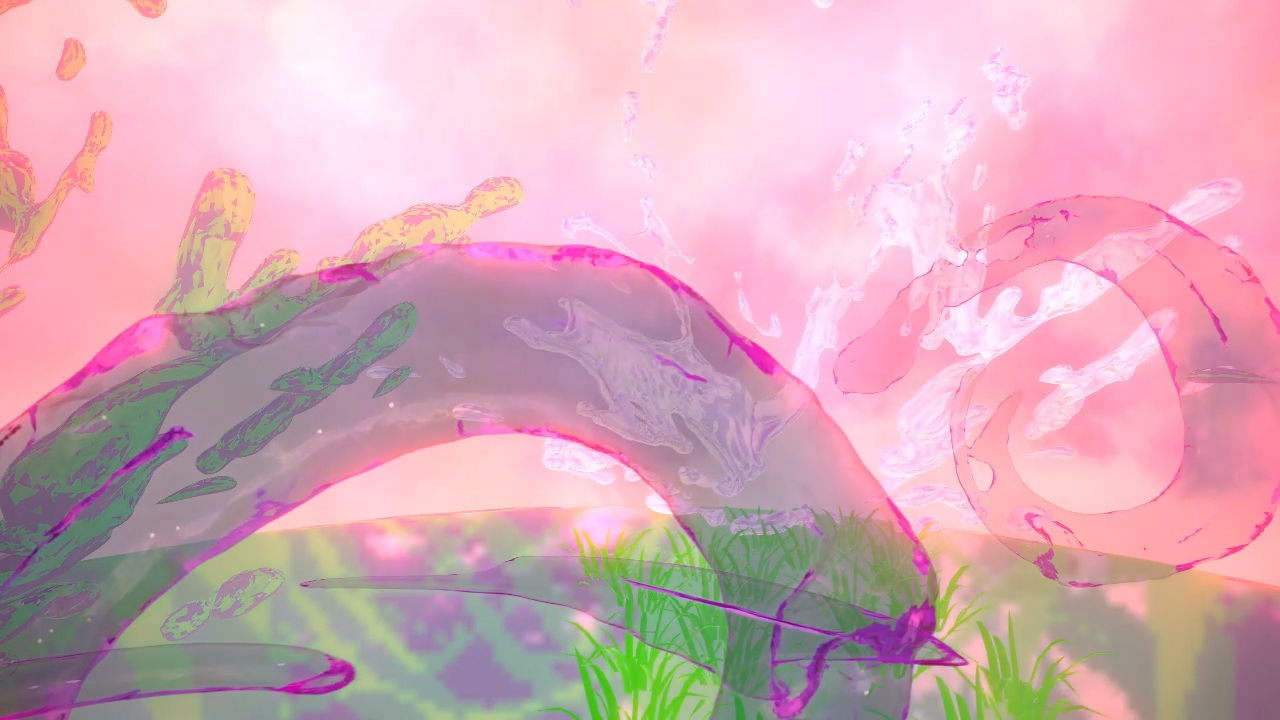
Figure 9: Watering the Somatic Oasis, VR Still (Ali 2023-2026).
Digital somatics connects the body to technology through immersion and practices of slowness in relation to our bodies and technology. How can we use technological mediums such as VR, AR and immersive technologies to slow down time? How can we use technology to heal and connect somatically to our bodies? As a world builder and digital storyteller, I use the framework of digital somatics, to connect back to our bodies and to call forth a more loving world. Digital technology is often coupled with instant gratification and speed; this can create an environment of anxiety and overconsumption of our precious resources. Digital somatics invites us to be guided by slowness and corporal sensation.
Digital somatics builds from the work of Neema Githere’s term ‘data healing’, where technology is imagined as modality of reparative care; Mindy Seu’s Cyberfeminism Index, a book project and archive that consider the feminine body and technology; and Olivia Mckayla Ross’ term ‘data trauma’, where data is assessed in ways it can compound harm, towards a connection with body, ecology and technology (Seu 2023, pp.32-24; Addae 2020).

Figure 10: Watering the Somatic Oasis, 3 custom cushions, misting stations, chairs, misting stations, headphones and floor projection (Ali, Souaga and Kampnagel 2023).
Through my immersive installations, Watering the somatic oasis (2023–ongoing) and Digital somatics: to breathe as stars do (2025), a solo exhibition, I use VR, sound, environmental tactility, and breath as portals for reconnection to our bodies, minds, and spirits. These spaces counter the ways we are typically socialised to interact with technology. When we are doomscrolling, our data is extracted with active informed consent, creating dopamine addictions and encouraging AI-induced psychosis (Preda 2025; De 2025).
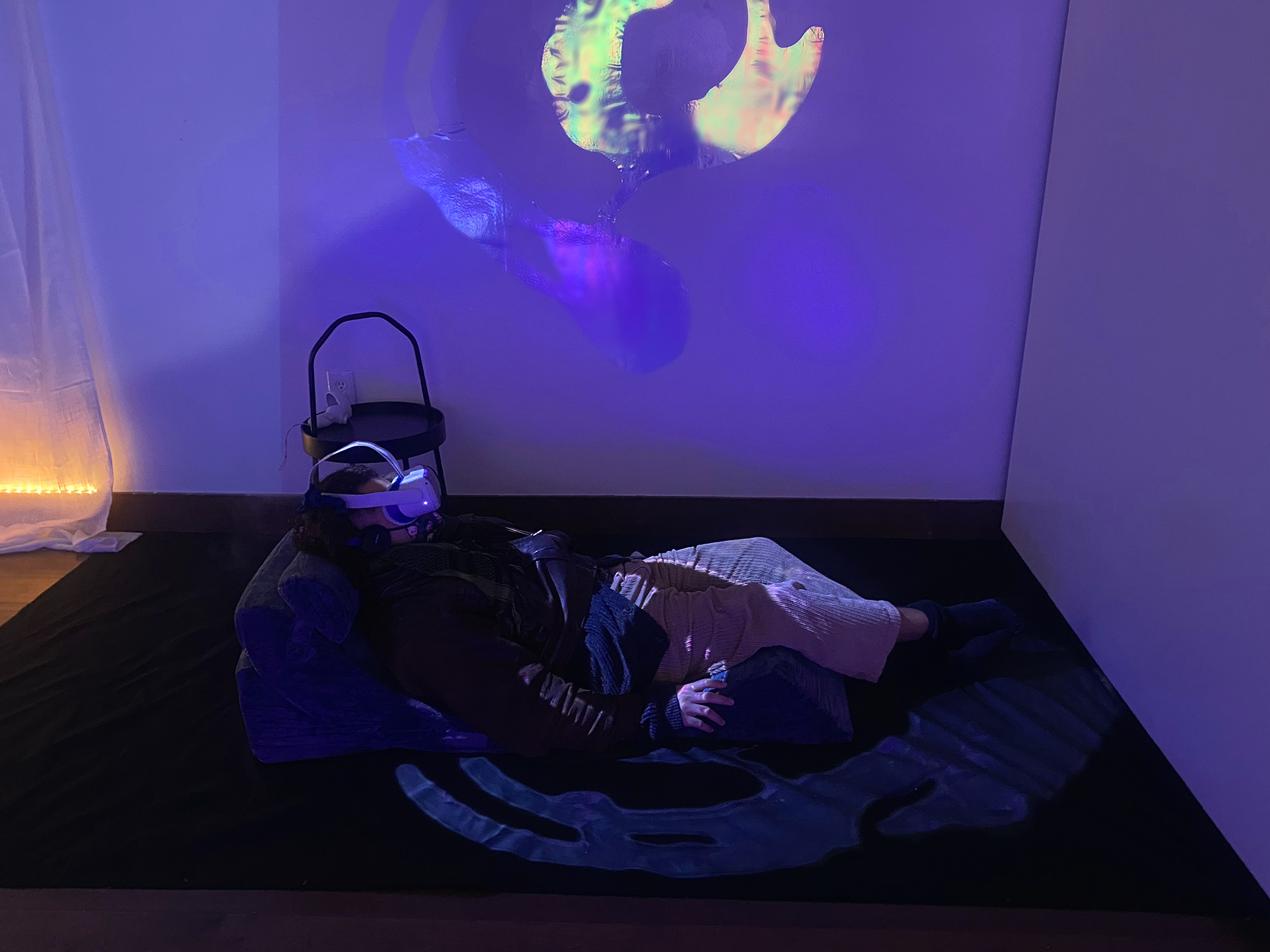
Figure 11: Digital Somatics: To breathe as stars do, Solo Exhibition, Ori Gallery, Portland, Oregon, 2 Virtual Reality (VR) headsets, headphones, stickers, custom-cushions, and chairs, misting stations, and spray paint (Ali 2025).
Watering the somatic oasis (2023-ongoing) is an internationally exhibited virtual reality installation that examines temporality, embodiment and technological acceleration through immersive and somatic practices. The work invites participants to enter a guided VR experience in which digital water, rhythm and bilateral movement techniques function as regulatory mechanisms for the nervous system. Visitors to the VR installation are guided to attune to the water by becoming as small as a water droplet. They are immersed in a sunset-pink watery environment through 3D floating water droplets, a looping meditation audio and through touch, as a motion-sensor water humidifier gently sprays all around them. Against the backdrop of AI-driven acceleration, platform temporality, and continuous optimisation, the installation proposes slowness as both an embodied methodology and a critical position, foregrounding duration, attentional presence and corporeal recalibration.
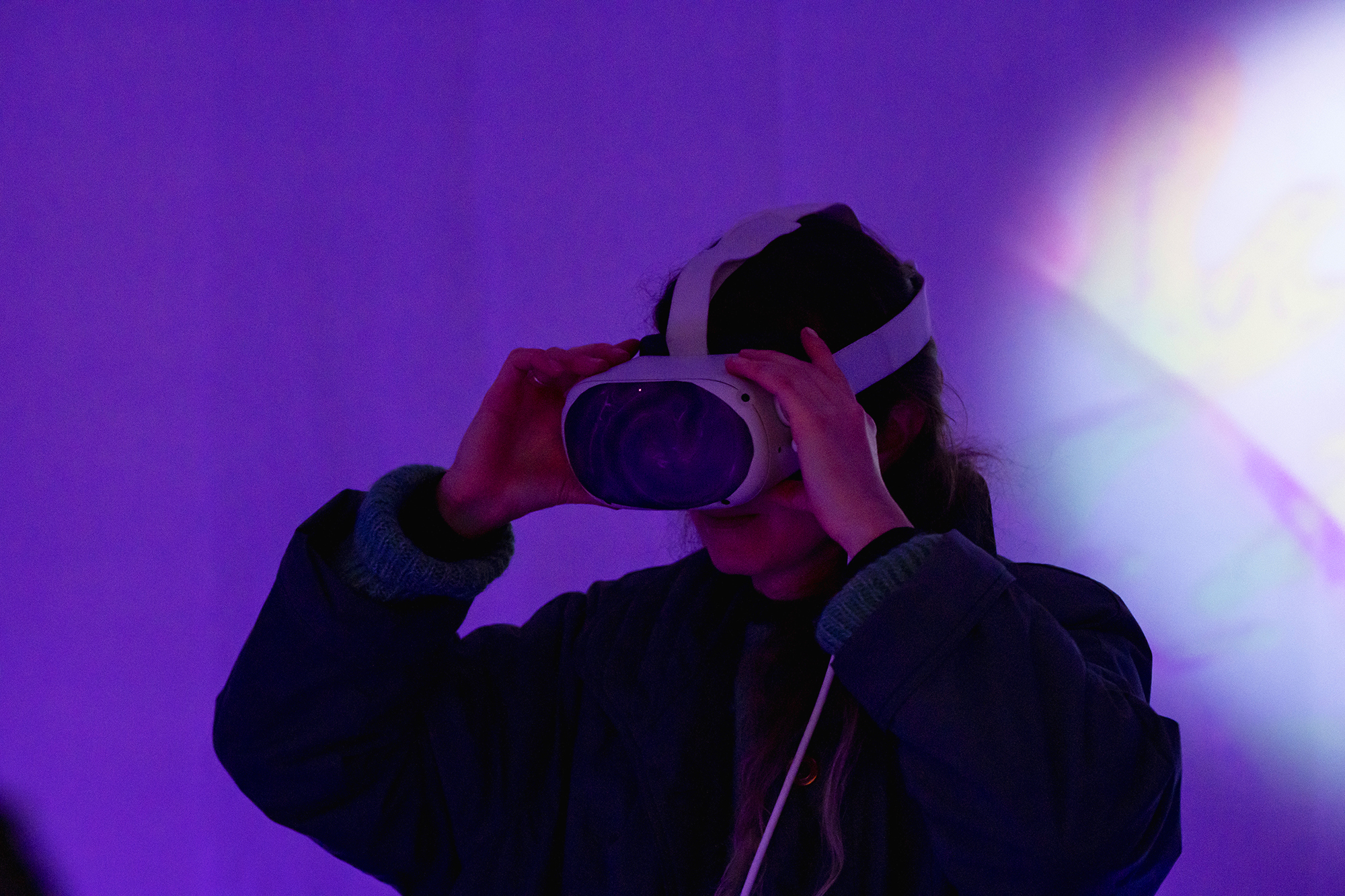
Figure 12: Watering the Somatic Oasis, Open Solitude at Akademie Schloss Solitude (Ali and Kleinbach 2025).
Watering the somatic oasis (2023-ongoing) was developed during Dreaming Beyond AI: In the Loop, a multidisciplinary, collaborative program that brought together artists, researchers, activists and policymakers to critically interrogate dominant imaginaries of artificial intelligence (Dreaming Beyond AI n.d.). The residency emphasised speculative, embodied and ethical approaches to AI, fostering alternative narratives beyond extractive and efficiency-driven technological paradigms. It was exhibited in 2023 in In The Loop at Kampnagel, Hamburg, in collaboration with Deichtorhallen Hamburg (Dreaming Beyond AI n.d.).
The work was subsequently featured in the solo exhibition Digital Somatics: To breathe as stars do at Ori Gallery (February 7 – April 30, 2025), Portland, Oregon. (Ori Gallery, 2025). The exhibition articulated an ongoing research-based practice of digital somatics, integrating immersive technologies, game engines, narrative world-building and somatic programming. Within this framework, technology is approached not as an instrument of acceleration but as a site for recalibrating perception, fostering repair and re-situating the body in relation to planetary and cosmic temporalities.
Through its iterative presentations across institutional, curatorial and research-driven contexts, Watering the Somatic Oasis (2023-ongoing) positions itself as a critical intervention in contemporary discourses on immersive media, embodied cognition, and technological time—advocating for slowness, care and somatic attention as necessary counter-practices within accelerated digital cultures. It is a critical intervention in creating an immersive meditative environment that visualises the principles of digital somatics.
I expanded these principles in an eponymously titled exhibition, Digital somatics: To breathe as stars do, where Watering the somatic oasis was installed in two diagonally-opposed alcoves, with Lullabies for tears (2024), a VR installation, arranged in an adjacent alcove. Visitors are guided by the star, my avatar, on a somatic body-processing journey.
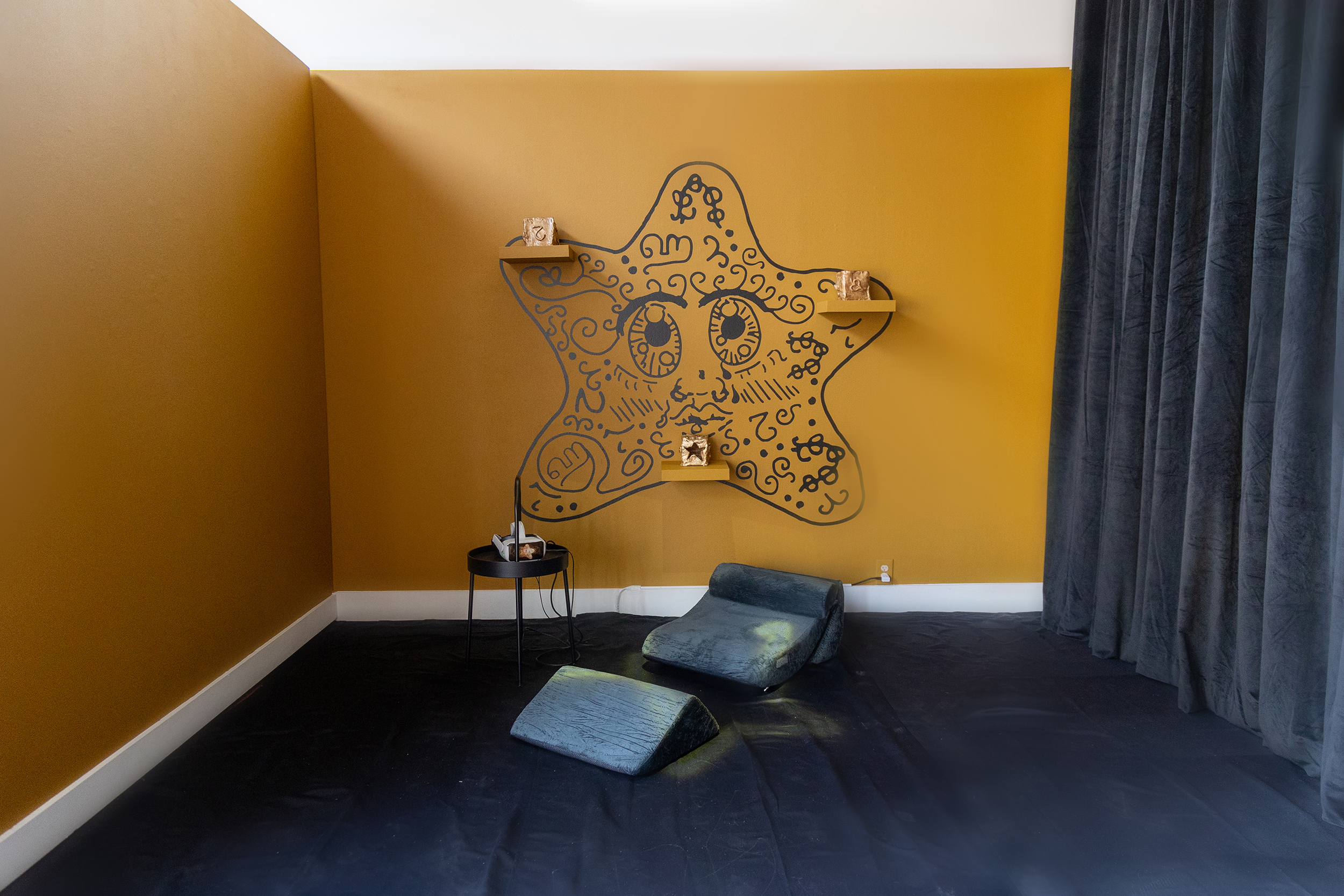
Figure 13: Lullabies for tears, VR installation as part of Lullabies for the stars in our eyes exhibition, Women and Their Work, Austin, TX, 2025, Video projection, VR headset, bakhoor incense, headphones, vinyl stickers (Ali and Essentials Creative 2024-2025).
In Lullabies for tears, a VR immersive installation, visitors are guided by the star (my avatar), and by bakhoor, a custom scent created by the artist, on a somatic body-processing journey. The star leads viewers through shimmer-and-sparkle-based breathwork that connects sensory experience with embodied reflection. In the work’s associated exhibition catalogue, Lullabies for the stars in our eyes, curator Nura Ali writes that the work “is a somatic journey into our sensorial body that brings with it an awareness of the primordial nature of our senses as our first means for understanding and mediating our experience of the world, but, more importantly, it also shows us avenues for coming back to ourselves, and consequently, back to the world” (Ali 2024). This somatic journey into our sensorial body brings an awareness of the primordial nature of our senses, particularly guiding us to tune into the stardust that surrounds us.
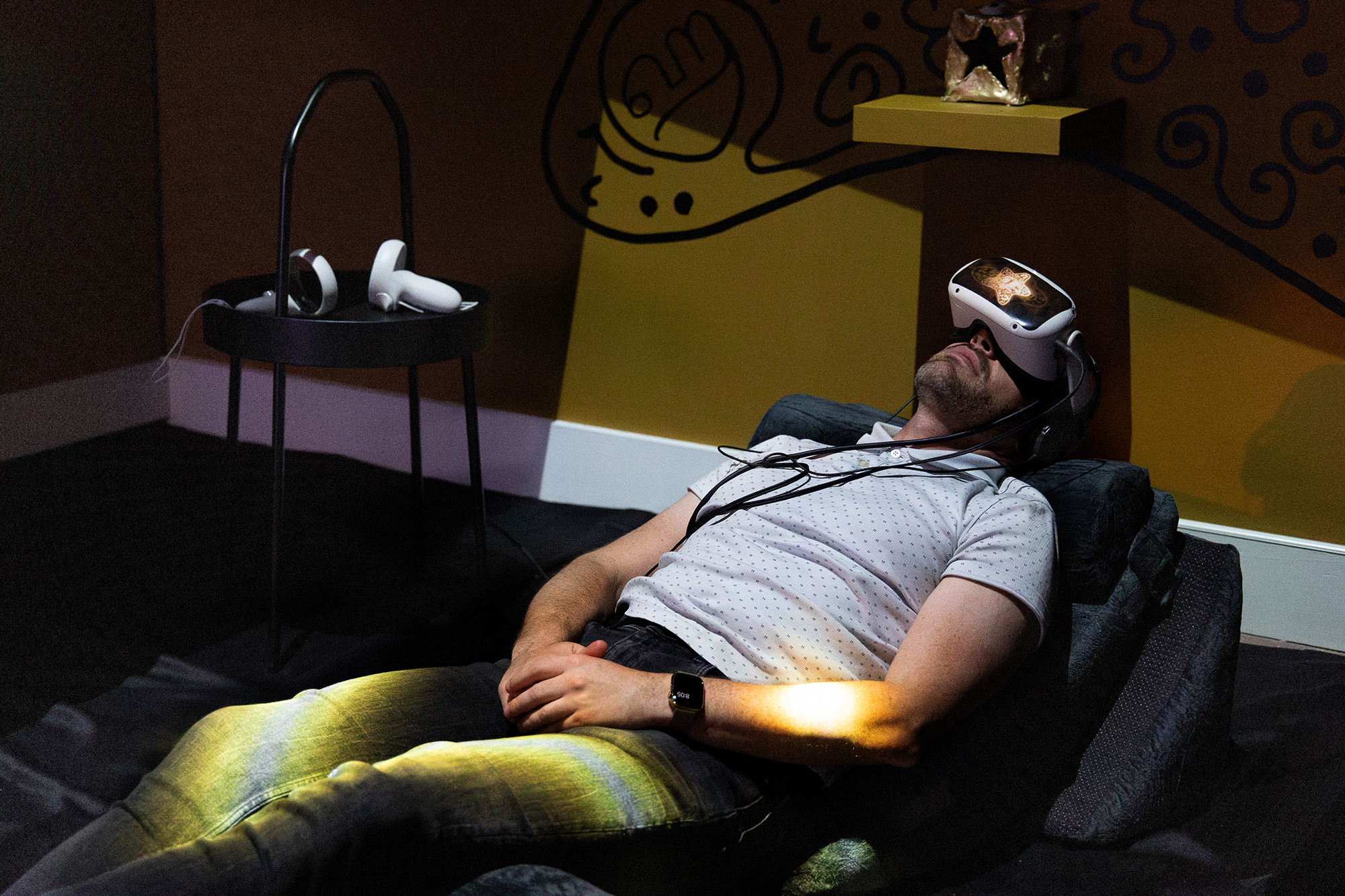
Figure 14: Lullabies for tears, VR installation as part of Lullabies for the stars in our eyes exhibition, Women and Their Work, Austin, TX, 2025, Video projection, VR headset, bakhoor incense, headphones, vinyl stickers (Ali and Essentials Creative 2024-2025).
Lullabies for tears was installed previously as a part of a solo exhibition, Lullabies for the stars in our eyes (2024), where curator Nura Ali writes, "We witness open-ended dancing bodies that exist as both multifarious entities and as chimeric avatars. These bodies—with flesh-borders porous enough to allow solid-seeming three-dimensional letters to rise out of their skin—collapse the separation between out and in, between this and that. Their pluralistic world-building allows the work in the exhibition to be both complicated and comprehensible, to have meanings and possible interpretations that change, slip and—rather like the human spirit—refuse to sit still as any one single thing" (Ali 2024). In 2023, a version of this work was previously exhibited as part of the concluding group exhibition for the Drinking Gourd Fellowship awarded by Nat Turner Projects at Oregon Contemporary in Portland, Oregon (Oregon Contemporary, 2023). Both of these somatic VR installations, Lullabies for tears (2024) and Watering the somatic oasis (2025), invite viewers to imagine what a different way of relation with digital mediated environments might look, feel and sound like.

Figure 15: Lullabies for the stars in our eyes exhibition, Women And Their Work Gallery, Austin, TX, 2024, 6 Video Projections, VR headset, bakhoor incense, headphones, vinyl stickers, sand, and reflective material (Ali and Essentials Creative 2024).
In Lullabies for the stars in our eyes solo exhibition, another immersive work was installed that centred the body and offered an invitation to slow down and connect to our shared environment (Ali 2024). Songs of the h’s video installation links the Indian Ocean littoral coastline to the bodies of people who inhabited it for time immemorial. The project reclaims the back of the throat as a metaphoric and literal space for healing. This part of the body holds the thyroid gland, which, due to intergenerational and compressed life-stressors, can trigger autoimmune diseases, a challenge that I navigate regularly. In popular culture, this part of the body is often referred to as the throat chakra, a place of communication and expression, and, as a turn of phrase, as a place where words get stuck. In this work, through a series of songs remixed in succession throughout the 18-minute and 33-second video, I reclaim the throat as a space of release and collective power, where we are not only heard but understood. In the installation, a double wall and three-floor projections were cast on reflective aluminium pools with sand mound sculptures, inviting the Indian Ocean coastline littoral into the gallery. Visitors were invited to engage in meditative mark-making and to connect to the landscape by leaving their imprints in the sand. Like water in our bodies, the landscape our ancestors inhabited is something we also carry.

Figure 16: Lullabies for the stars in our eyes exhibition, Women and Their Work Gallery, Austin, TX, 2024, Video projection, VR headset, bakhoor incense, headphones, vinyl stickers, sand and reflective material (Ali and Essentials Creative 2024).
Each work invites the body to slow down—to inhale, exhale, to see one’s breath rendered as tidal light and fluid motion. In Watering the somatic oasis (2023-ongoing), Lullabies for tears (2024) and Songs of the h’s (2024), the latter two were both featured in the solo exhibition, Lullabies for the stars in our eyes (2024), where singing and activating the throat is tied to breathwork and slowly feeling through the body (Ali, 2024). Through a countermap of digital somatics, the body becomes a central interface. Technology here is not extraction but an extension; it is as a vessel for interiority, a medium of return. The digital somatic is thus a practice of re-membering the body within the digital. As living beings, we have more than five senses; there is unlimited potential for imagination with ecosomatic ways of storytelling, archiving and world-building.

Figure 17: Lullabies for the stars in our eyes exhibition, Women and Their Work Gallery, Austin, TX, 2024, Video projection, VR headset, bakhoor incense, headphones, vinyl stickers, sand and reflective material (Ali and Essentials Creative 2024).
Conclusion: Countermaps of connections and care
At a moment when AI is frequently framed as the primary site of intelligence, creativity and agency, these countermapping practices grounded in ecosomatics ask us to reconsider where intelligence resides and whose knowledge is valued.
These methods of digital somatics and ocean-sensing function as countermaps not only because they visualise alternative territories of knowledge, but because they challenge the very cartographies through which intelligence is currently defined. AI systems increasingly operate through acts of mapping: extracting patterns from bodies, environments and collective histories to render the world computationally legible.
Countermapping resists narratives that privilege computational forms of knowing over the intelligence of bodies, waters, landscapes and more-than-human collectivities. Instead, they propose technologies that deepen, rather than replace, our relationships with the living world. Countermaps offered by the ecosomatics approaches of digital somatics and ocean sensing transform computation from an act of command into a field of correspondence, attuning human and nonhuman, biological and machinic, watery and electrical. In this sense, countermapping becomes an act of world-building: a process of creating new orientations, expanding the limits of collective imagination, and making visible the relationships and knowledges that dominant systems have rendered absent
Through ecosomatic practices, intelligence emerges not as a capacity possessed by autonomous systems, but as a relational process distributed across bodies, ecosystems, technologies and more-than-human entities. In digital somatics, this relational intelligence emerges through attention to embodied perception and affective experience, challenging computational models that separate data from the bodies and conditions that produce it. Likewise, ocean sensing reframes environmental technologies away from extraction and surveillance, proposing forms of sensing that emerge through listening, reciprocity and ecological entanglement.
Against extractive forms of computational labour, where bodies, environments and experiences are transformed into resources for prediction and optimisation, ecosomatic practices offer forms of labour that are attentive, reciprocal and restorative, expanding our collective imagination beyond extractive models of intelligence. This ecosomatic method and practice invites us to imagine intelligence as interdependence: a shared pulse, a shifting tide. Through digital somatics and ocean sensing, technology is repositioned not as a tool for extraction, optimisation or control, but as a medium for cultivating embodied attention and reciprocal relationships with the living world. Rather than taking colonial and extractive maps as the point of departure, these practices invite us to sense with, rather than merely sense about, oceans, waters and environments, foregrounding care, relationality and collective responsibility. To unlearn extractive intelligence is to remember that the body, too, is mineral and wave, coded by water, resonant with the planet’s breath. Rather than reproducing the detached, objective gaze that has historically characterised both colonial mapping and contemporary technological systems, these practices require us to put our bodies on the line. They cultivate situated, embodied and accountable forms of perception in which knowledge emerges through participation, vulnerability and reciprocal relationships with the more-than-human world.
Through countermaps offered by ocean sensing and digital somatics, I articulate an alternative intelligence to the dominant AI imaginary: one that moves not through domination but through drift—slow, rhythmic and alive to the world’s subaqueous murmur. When we tune collectively in this vision, our worlds change, and, with that, our expanded sense of the body shifts the universe around us towards liberation and its many beyonds.